Are you a business owner contemplating a major transition like selling your company or merging with another entity? Understanding mergers advisory services can be the key to unlocking maximum value from such complex transactions. These specialized services provide expert guidance through the intricate world of mergers and acquisitions, ensuring you navigate every step with confidence and achieve optimal outcomes.
In this comprehensive guide, we dive deep into what mergers advisory services entail, why they matter, and how they can transform your business exit or growth strategy. Drawing from years of hands-on experience in facilitating successful deals, Legacy Launch Business Brokers has helped countless entrepreneurs realize their legacy goals. Whether you're preparing to retire, scale up, or restructure, professional advisory support makes all the difference.
What Exactly Are Mergers Advisory Services?
Mergers advisory services refer to professional consulting offered by specialized firms to assist businesses, private equity groups, and corporations in executing mergers, acquisitions, sales, or restructurings. These services go beyond basic brokerage, encompassing strategic planning, valuation expertise, negotiation support, and post-deal integration advice. At their core, they help clients identify the best options for transactions, from initial market analysis to final closing.
Unlike general business brokers who focus solely on matching buyers and sellers, mergers advisors provide end-to-end support. This includes pre-transaction preparation like confidential marketing materials, financial modeling, and buyer sourcing, as well as handling due diligence, regulatory compliance, and deal structuring. For sell-side clients, advisors maximize sale prices; for buy-side, they ensure acquisitions align with strategic goals and deliver long-term value.
Consider a mid-sized manufacturing firm looking to sell after decades of operation. Without proper advisory, the owner risks undervaluing the business or attracting unqualified buyers. With expert mergers advisory services, the team conducts thorough valuations, targets strategic acquirers, and negotiates terms that reflect true enterprise value, often including earnouts for future performance.
Why Do Businesses Need Mergers Advisory Services?
The mergers and acquisitions landscape is fraught with challenges: volatile markets, regulatory hurdles, competitive bidding, and emotional decision-making. Statistics show that up to 70-90% of M&A deals fail to deliver expected synergies due to poor planning or execution. Professional advisors mitigate these risks by leveraging deep industry knowledge and proven processes.
Key benefits include achieving higher transaction values—advisors often secure 20-30% premiums over unassisted sales through competitive auctions and negotiation prowess. They also save time, shielding owners from daily distractions during the sale process. Moreover, advisors bring confidentiality, marketing to a vast network of qualified buyers without public disclosure that could unsettle employees or customers.
For buyers, advisory services ensure due diligence uncovers hidden liabilities, valuations are realistic, and integration plans are solid. In essence, these services turn high-stakes gambles into calculated strategies, protecting stakeholder interests and paving the way for seamless transitions.
Core Components of Mergers Advisory Services
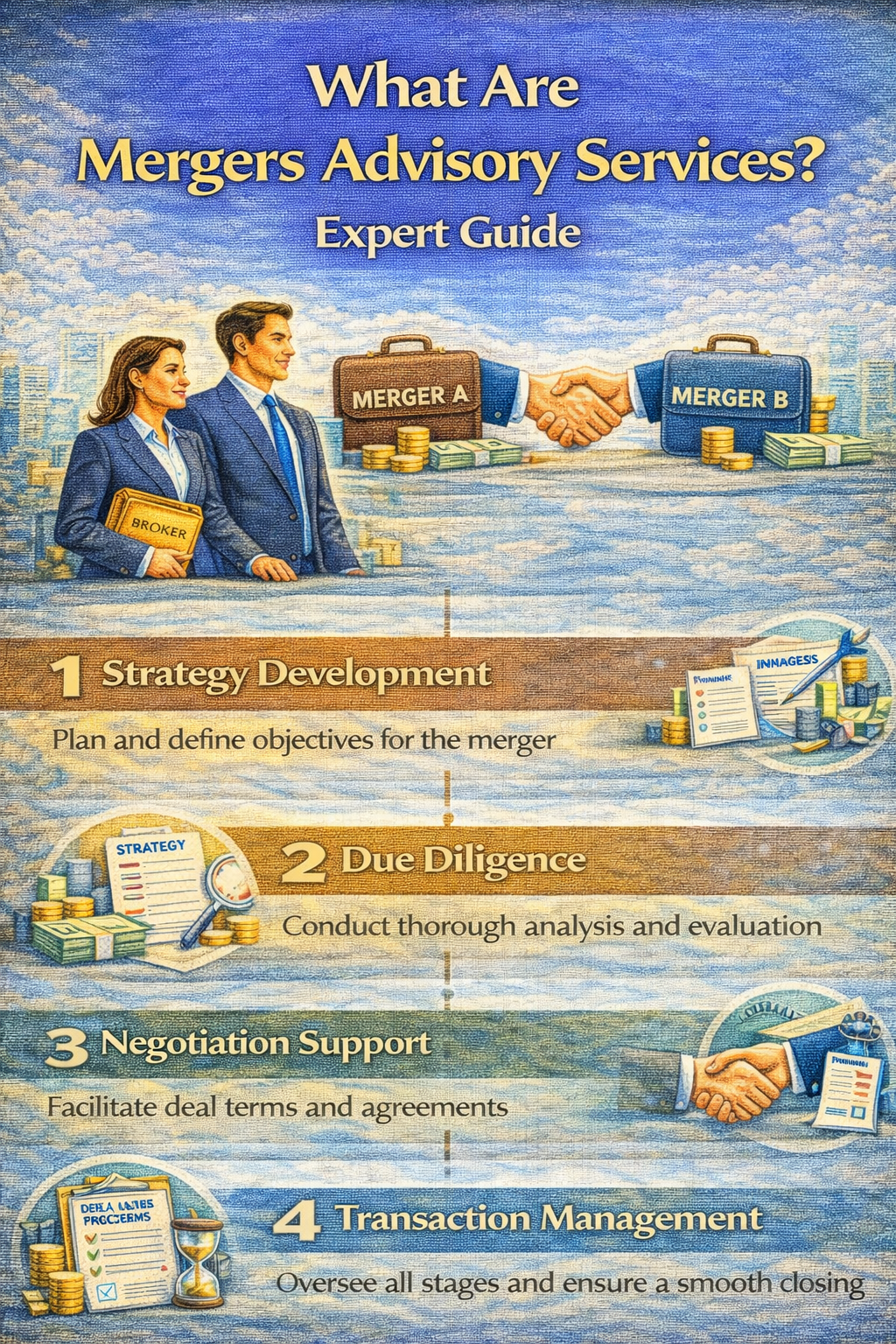
Mergers advisory engagements typically unfold in structured phases, each critical to success.
1. Strategic Planning and Valuation
The foundation of any deal is accurate business valuation. Advisors employ methods like discounted cash flow analysis, comparable company multiples, and precedent transactions to determine fair market value. They factor in tangible assets, intellectual property, recurring revenue streams, and growth potential. For instance, a SaaS company might command higher multiples based on customer retention metrics and scalable tech infrastructure.
Strategic planning involves defining exit objectives: Is it a full sale, partial divestiture, or management buyout? Advisors align these with market timing, economic conditions, and buyer appetites, crafting a roadmap tailored to unique business circumstances.
2. Buyer/Seller Sourcing and Marketing
Confidential marketing is an art. Advisors prepare teaser documents, confidential information memorandums (CIMs), and management presentations that highlight strengths without revealing sensitive data. They tap proprietary databases and networks to approach strategic buyers, financial sponsors, and industry peers.
In competitive processes, advisors manage auctions, solicit bids, and foster bidding wars that drive up prices. For buy-side mandates, they screen targets, perform preliminary valuations, and facilitate introductions.
3. Negotiation and Deal Structuring
Skilled negotiation separates good deals from great ones. Advisors advocate for favorable terms on purchase price, working capital adjustments, reps and warranties, indemnities, and earnouts. They anticipate counteroffers and use data-driven arguments to protect client interests.
Deal structuring optimizes tax efficiency, financing, and risk allocation—perhaps blending cash, stock, and seller notes for mutual benefit.
4. Due Diligence and Closing
Due diligence is rigorous: financial audits, legal reviews, operational assessments, and customer/supplier validations. Advisors coordinate virtual data rooms, respond to buyer queries, and address red flags proactively.
Closing involves finalizing documents, securing approvals, and wiring funds. Post-closing, some provide integration support to realize synergies.
Explore detailed Legacy Launch Mergers Advisory Services to see how these components are applied in practice.
How Mergers Advisory Services Differ from Business Brokerage
While often confused, mergers advisory services target larger, more complex transactions than standard brokerage. Business brokers handle smaller deals under $5 million, focusing on local buyers. Mergers advisors specialize in middle-market deals ($5-100 million+), engaging sophisticated buyers like private equity and corporations.
Advisors offer investment banking-level sophistication: advanced financial modeling, industry research, and global networks. They charge success fees (1-5% of deal value) plus retainers, reflecting higher value delivered. Brokers typically work on lower commissions for simpler matchmaking.
Legacy Launch Business Brokers bridges this gap, providing Legacy Launch Business Brokers expertise for owners seeking premium outcomes without bulge-bracket complexity.
Real-World Examples of Successful Mergers Advisory
From experience, one standout case involved a family-owned logistics firm with $25 million in revenue. The owners wanted to retire but feared fragmenting the legacy. Our advisory team valued the business at 6x EBITDA, marketed to national carriers, and orchestrated a competitive process yielding a 25% premium. The deal closed smoothly, with earnouts ensuring continuity.
Another example: A tech services provider acquired a competitor to expand offerings. Advisors identified synergies, negotiated a stock-for-stock merger, and managed integration, boosting combined revenue by 40% post-deal.
These cases illustrate how tailored advisory turns aspirations into reality, preserving value and legacies.
Choosing the Right Mergers Advisory Partner
Select advisors with proven track records in your industry, transparent processes, and aligned incentives. Look for credentials like CFA designations, deal registries, and client testimonials. At Legacy Launch, our team's collective experience spans hundreds of transactions, emphasizing confidentiality and owner-centric strategies.
Key questions to ask: What's your success rate? How many similar deals have you closed? What’s your network like? Ensure fee structures are clear—retainer for commitment, success fee for results.
Learn more about our Legacy Launch Business Valuation Services, a cornerstone of effective advisory.
Common Pitfalls in M&A Without Advisory Support
DIY deals often falter: Owners undervalue assets, leak confidentiality, or accept first offers. Emotional attachments lead to suboptimal terms. Without experts, tax inefficiencies erode proceeds, and disputes derail closings.
Advisors prevent these by benchmarking against market comps, enforcing NDAs, and mediating impartially. Data shows advised deals close 50% faster and at higher multiples.
The Future of Mergers Advisory Services
Trends like AI-driven valuations, ESG integration, and cross-border deals are reshaping the field. Advisors adapt with tech tools for faster due diligence and blockchain for secure data rooms. Private equity's appetite for middle-market assets continues to grow, creating opportunities for sellers.
Post-pandemic, hybrid work and digital transformation influence valuations, rewarding adaptable businesses. Forward-thinking advisors position clients to capitalize on these shifts.
Frequently Asked Questions
What are mergers advisory services exactly?
Mergers advisory services are comprehensive professional consultations designed to guide businesses through mergers, acquisitions, sales, or restructurings. They encompass strategic planning, business valuation, buyer or seller sourcing, negotiation, due diligence coordination, and post-transaction support. Unlike basic matchmaking, these services involve in-depth financial analysis, market research, and deal structuring to maximize value and minimize risks. For sellers, advisors prepare confidential marketing materials and run competitive processes to attract top bids. For buyers, they identify targets, perform preliminary assessments, and ensure alignment with strategic goals. This end-to-end expertise is crucial in complex middle-market transactions where stakes are high and pitfalls abound. Experienced firms like those specializing in legacy transitions bring proprietary networks and proven methodologies to deliver outcomes far superior to unassisted efforts. Ultimately, these services transform daunting processes into strategic opportunities for growth or profitable exits, safeguarding business legacies while optimizing financial returns.
How do mergers advisory services benefit business owners?
Business owners gain immensely from mergers advisory services through higher sale prices, faster closings, and reduced stress. Advisors secure 20-30% premiums via competitive auctions and expert negotiations, leveraging data on comparable deals. They handle all marketing and due diligence, freeing owners from distractions that could harm operations. Confidentiality is paramount—materials are shared only under NDAs with qualified parties. Tax-efficient structuring preserves more proceeds, while risk mitigation via thorough warranties protects against post-sale liabilities. For buyers, advisors ensure acquisitions deliver synergies without overpaying. Long-term, these services facilitate smooth transitions, whether to retirement, family succession, or new ventures. Real results include deals closing in 6-9 months versus years for DIY attempts, with integrated earnouts tying payouts to performance. Trustworthy advisors align with owner goals, providing transparent processes and full accountability, turning potential chaos into controlled, value-maximizing events.
What is the process of engaging mergers advisory services?
Engaging mergers advisory services starts with an initial consultation to assess goals, timeline, and business readiness. Advisors then perform a preliminary valuation and market scan to set expectations. Upon agreement, a retainer secures exclusivity, followed by in-depth analysis: financial audits, CIM preparation, and target lists. Marketing launches confidentially, soliciting indications of interest (IOIs), then letters of intent (LOIs). Selected bidders enter management meetings and due diligence, where advisors manage data rooms and queries. Negotiations refine terms, leading to definitive agreements. Closing involves legal finalization and fund transfers. Post-closing support aids integration. The entire process typically spans 6-12 months, with weekly updates ensuring alignment. Experienced providers customize phases to business type—faster for asset sales, thorough for full enterprises—delivering efficiency without compromising thoroughness.
How much do mergers advisory services cost?
Mergers advisory fees blend retainers and success-based commissions. Retainers ($50,000-$250,000) cover upfront work like valuations and marketing, ensuring advisor commitment. Success fees range 1-5% of transaction value, tiered by size—higher for smaller deals, lower for larger. For a $10 million sale, fees might total $400,000-$600,000, far offset by premiums achieved. No-win-no-fee structures motivate results, with retainers creditable against final payout. Buyers pay similarly, often flat fees for targeted searches. Transparent firms disclose structures upfront, avoiding hidden costs. Compared to investment banks' Lehman formulas, middle-market advisors offer competitive rates with personalized service, making professional help accessible for $5-100 million enterprises.
Who typically uses mergers advisory services?
Mergers advisory services serve diverse clients: retiring owners exiting after building lifelong enterprises, private equity firms consolidating portfolios, corporations pursuing growth via bolt-ons, and family businesses planning successions. Middle-market companies ($5-100 million revenue) are primary users, valuing expertise beyond local brokers. Strategic buyers seek synergies; financial buyers focus on cash flows. Industries span manufacturing, tech, healthcare, and services, where complexity demands specialists. Even non-M&A needs like recapitalizations or joint ventures benefit. Firms like Legacy Launch cater to legacy-minded owners prioritizing smooth transitions over quick flips, ensuring cultural fits and employee retention.
What role does valuation play in mergers advisory?
Valuation is the cornerstone of mergers advisory, anchoring pricing, negotiations, and expectations. Advisors use DCF for future cash flows, precedent transactions for market comps, and guideline public companies for multiples. Adjustments account for synergies, risks, and control premiums. For sellers, robust valuations justify asking prices; for buyers, they flag overpays. Iterative refinements occur as diligence reveals data. Accurate valuations drive 20-40% value variances, underscoring expert necessity. Tools like normalized EBITDA highlight true earning power, while scenario modeling prepares for sensitivities.
How long does a mergers advisory process take?
A typical mergers advisory process lasts 6-12 months, varying by deal size and complexity. Preparation (1-2 months) includes valuation and materials. Marketing and IOIs (2-3 months) yield LOIs. Diligence and negotiation (2-4 months) culminate in closing. Smaller deals accelerate; regulatory-heavy ones extend. Advisors compress timelines via efficient auctions and pre-vetted buyers, achieving sub-6-month closes versus years for protracted efforts.
Are mergers advisory services only for large corporations?
No, mergers advisory services are ideal for middle-market businesses ($5-100 million), where complexity warrants expertise but bulge-bracket fees are prohibitive. Owners of established firms benefit most, gaining access to national buyer pools and sophisticated structuring unavailable locally. Scalable models suit $2-200 million deals, democratizing high-end advice.
What happens after a merger advisory deal closes?
Post-closing, advisors often provide integration support: cultural alignment, system merges, staff retention plans. Earnouts are monitored for payouts. Sellers transition via consulting agreements. Buyers realize synergies through operational tweaks. This phase ensures sustained value, mitigating 70% of failure risks from poor integration.
How to prepare your business for mergers advisory services?
Preparation maximizes outcomes: Clean financials (3 years normalized), update legal docs, document processes, secure key contracts. Build management depth for owner absence. Articulate strategic rationale. Advisors assist audits, but proactive steps accelerate processes and boost valuations by evidencing scalability.
Conclusion
Mergers advisory services empower business owners to navigate complex transactions with expert precision, securing legacies and financial futures. Partnering with proven providers like Legacy Launch Business Brokers ensures comprehensive support from valuation to close. Ready to explore your options? Start by connecting with specialists who prioritize your success.