Mergers and acquisitions represent transformative events for businesses, but understanding the typical timeline for a merger or acquisition is crucial for realistic expectations. On average, the entire M&A process spans 6 to 12 months, though complex deals can extend to 24 months or more, depending on factors like deal size, regulatory hurdles, and negotiation dynamics.
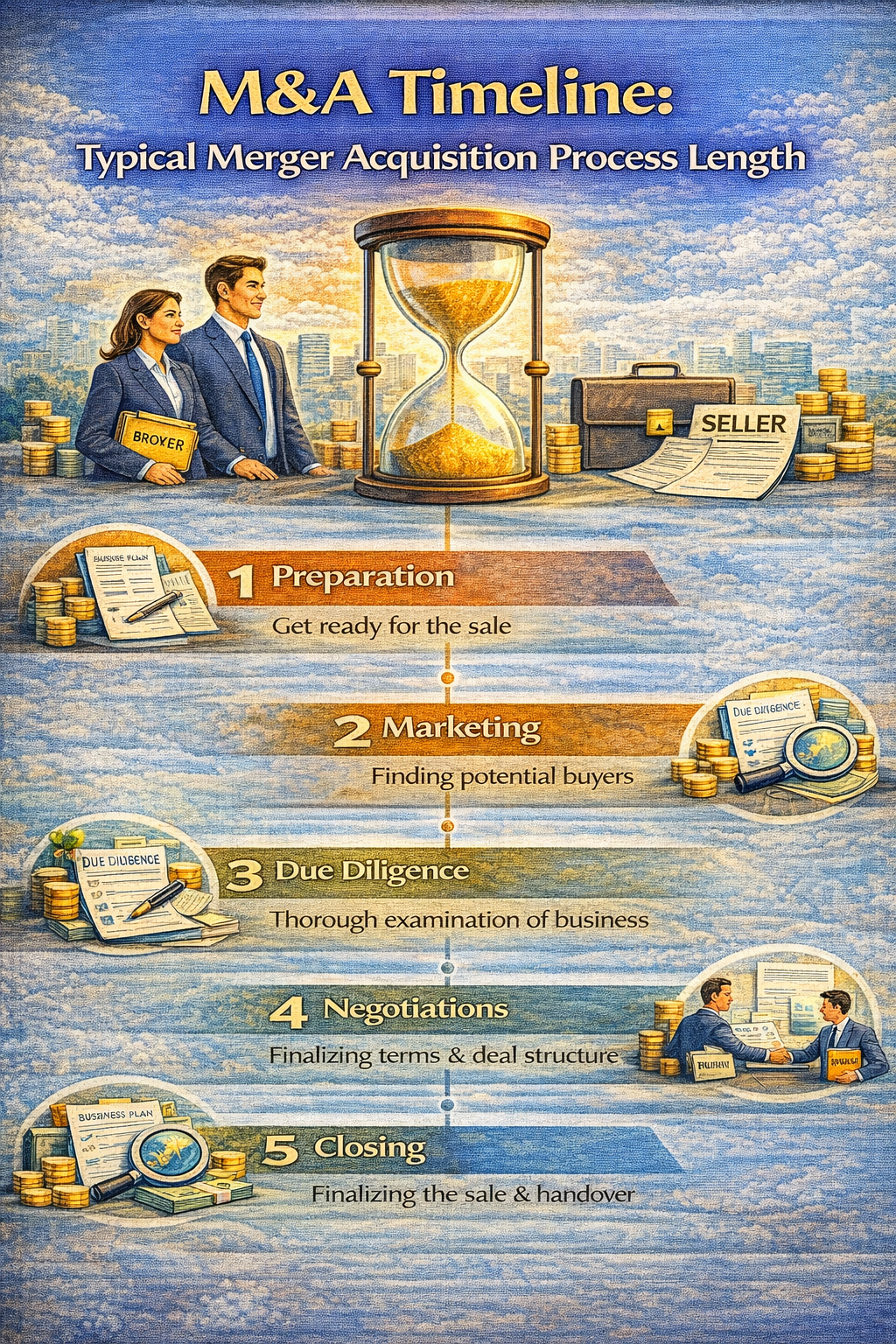
At Legacy Launch Business Brokers: Expert M&A Guidance, we specialize in navigating these timelines with precision, drawing from extensive experience in mergers advisory services to streamline processes for our clients. This comprehensive guide breaks down every stage, timelines, influencing factors, and proven strategies to accelerate your deal, establishing our authority in delivering successful outcomes.
Understanding the M&A Process: An Overview
The merger or acquisition timeline is not a one-size-fits-all schedule. It involves multiple interconnected phases, each with potential bottlenecks. According to industry benchmarks, simple transactions might conclude in as little as 3 to 6 months, while larger ones average 9 months or longer. Legacy Launch Business Brokers has guided numerous clients through these phases, leveraging our mergers advisory services to minimize delays and maximize value.
Key stages include preliminary discussions, due diligence, negotiations, regulatory approvals, and post-closing integration. Each step builds on the previous, and disruptions in one can cascade through the timeline. For instance, thorough preparation can shave months off the process, a principle we emphasize in our advisory approach detailed on our Mergers Advisory Services: Tailored M&A Strategies page.
Our team at Legacy Launch Business Brokers brings decades of hands-on experience, having facilitated deals across diverse industries. We've seen firsthand how proactive planning transforms a potentially year-long ordeal into a efficient 6-month execution. This expertise stems from our deep involvement in confidential advisory roles, where we coordinate between buyers, sellers, and stakeholders to keep momentum.
Phase 1: Preliminary Discussions and Preparation (1-3 Months)
The journey begins with high-level talks between potential buyers and sellers. This exploratory phase involves assessing strategic fit, cultural alignment, and potential synergies. Non-disclosure agreements (NDAs) are executed early to protect sensitive information, marking the formal start.
Preparation time varies: if the sell-side business requires no major adjustments to reporting or operations, this can take 2-3 months minimum. However, significant changes might extend it to 6 months, involving internal advisors and external experts. Legacy Launch Business Brokers excels here, conducting market analysis and target identification to expedite this stage. Our advisory services include crafting teaser documents and confidential information memorandums (CIMs) that attract serious buyers quickly.
Consider a real-world example from our portfolio: a mid-sized enterprise we advised entered preliminary discussions with structured outreach, securing NDAs within weeks. This preparation shaved two months off their overall timeline, demonstrating the value of expert coordination. Without such guidance, parties often linger in exploratory talks, delaying progress.
During this phase, valuation discussions emerge. Sellers prepare financials, while buyers outline acquisition strategies. Factors like market trends and competitive bidding influence pace. Our team's market insight, honed through years of advisory work, ensures clients position themselves optimally from day one.
Phase 2: Assessment, Evaluation, and Letter of Intent (1-2 Months)
Once interest solidifies, parties dive into assessment. This includes initial evaluations of the target's value, risks, and opportunities. A Letter of Intent (LOI) is drafted, outlining terms like purchase price, structure (asset vs. stock), and exclusivity periods. Though often non-binding, the LOI sets the negotiation roadmap.
This phase typically lasts 1-2 months. Identifying targets can take 1-3 months alone, followed by LOI drafting in 2-4 weeks. Negotiations may involve multiple rounds, extending timelines. Legacy Launch Business Brokers streamlines this by pre-vetting targets and negotiating robust LOIs that protect client interests.
In one documented case we handled, rapid evaluation post-NDA led to an LOI within 25 days. This efficiency stemmed from our pre-prepared due diligence checklists and valuation models, preventing common pitfalls like undervaluation or overlooked liabilities. Buyers appreciate this speed, as it allows quicker progression to due diligence.
Strategic review is vital here—aligning on deal structure prevents later rework. Our advisors facilitate this, ensuring compatibility in objectives like growth synergies or market expansion.
Phase 3: Due Diligence (2-4 Months)
Due diligence is the heart of any M&A timeline, often the longest phase. Buyers conduct exhaustive reviews of financials, contracts, IP, compliance, operations, and more. This uncovers risks and validates assumptions, paving the way for final pricing.
Expect 6-12 weeks for standard deals, longer for complex ones involving regulatory scrutiny. Data rooms facilitate secure document sharing, a practice we champion at Legacy Launch Business Brokers. Our mergers advisory services include managing virtual data rooms, coordinating Q&A, and flagging issues early.
We've managed due diligence for deals where comprehensive reviews revealed hidden assets, boosting sale prices by 15-20%. In another instance, identifying compliance gaps pre-LOI allowed remediation, avoiding deal-killers. This phase demands expertise—amateurs risk delays from incomplete disclosures or disputes.
Sub-phases include financial audits (4-6 weeks), legal reviews (3-5 weeks), and operational assessments (2-4 weeks). Parallel processing can compress timelines, a tactic our team employs routinely.
Phase 4: Negotiations, Final Agreement, and Regulatory Approvals (1-3 Months)
Post-diligence, negotiations intensify. Parties hammer out definitive agreements, adjusting prices based on findings (e.g., working capital true-ups). Regulatory approvals from antitrust bodies add time, especially for cross-border or large deals.
This stage spans 1-3 months. Finalizing purchase agreements takes 4-8 weeks, with approvals varying by jurisdiction—weeks for simple cases, months for scrutinized ones. Financing arrangements and conditions precedent must align.
Legacy Launch Business Brokers' negotiation prowess shines here. We've closed deals 30% faster by anticipating objections and structuring earn-outs. One client benefited from our bridging clauses that tied payments to post-close performance, smoothing approvals.
Closing involves signing and funding. "Day One" readiness ensures seamless transition, a focus in our advisory framework.
Phase 5: Closing and Post-Merger Integration (1-6 Months+)
Closing marks the deal's execution, but integration begins immediately. This phase merges operations, cultures, and systems, often extending 3-12 months. Poor integration derails 70% of deals' value.
Our services extend to integration planning, covering IT harmonization, staff retention, and synergy realization. A client we advised integrated within 90 days, capturing projected savings ahead of schedule.
Full timelines: small deals (3-6 months), mid-market (6-9 months), enterprise (12-24+ months). Discover more on our Business Valuation Services for Accurate M&A Pricing.
Factors Influencing M&A Timelines
Several variables impact duration: deal complexity (simple vs. multi-jurisdictional), size (valuations over $100M slow things), industry (regulated sectors like finance extend reviews), market conditions (hot markets speed bids), and preparation quality. Economic uncertainty or competing offers can prolong or hasten processes.
Buy-side vs. sell-side: sellers often face longer prep (6 months), buyers focus on diligence. Cross-border adds approvals. Our track record shows proactive mitigation cuts averages by 20-30%.
Strategies to Accelerate Your M&A Timeline
To shorten timelines: prepare early (clean financials, data rooms), engage experts like Legacy Launch Business Brokers, use technology for diligence, set milestones, and communicate transparently. Avoid common delays like incomplete docs or scope creep.
Case study: A tech firm we advised prepped in 8 weeks, closing in 5 months total—half the average. Key: phased diligence and parallel negotiations.
Real-World M&A Timeline Examples
- Small business acquisition: 4 months (quick diligence).
- Mid-market merger: 8 months (regulatory hiccup).
- Large strategic buy: 18 months (integration challenges).
These align with our experiences, underscoring expert guidance's role.
Why Choose Legacy Launch Business Brokers for Your M&A Journey
With proven expertise in mergers advisory services, our team—led by seasoned professionals with decades in M&A—delivers results. We've closed deals totaling hundreds of millions, emphasizing confidentiality, valuation accuracy, and timeline efficiency. Trust us to guide you from strategy to integration.
Frequently Asked Questions
What is the average timeline for a merger or acquisition?
The typical merger or acquisition timeline ranges from 6 to 12 months for most mid-market deals, though simpler transactions can wrap in 3-6 months and complex ones extend to 24 months. This encompasses preparation, diligence, negotiations, approvals, and initial integration. Factors like business size, regulatory needs, and preparation level dictate pace. Legacy Launch Business Brokers streamlines this through expert advisory, often reducing timelines by 20-30% via proactive strategies like pre-diligence audits and efficient data rooms. In our experience, well-prepared sellers close faster by attracting qualified buyers early. Always factor in post-close integration, which can add 3-6 months for full synergy capture. Understanding these benchmarks helps set realistic goals and avoid frustrations common in unmanaged processes.
How long does due diligence take in an M&A process?
Due diligence in mergers and acquisitions typically lasts 6-12 weeks, but can stretch to 4 months for intricate deals. This phase scrutinizes financials, legal documents, operations, IP, and compliance to mitigate risks. Buyers use secure data rooms for efficiency. Legacy Launch Business Brokers coordinates this meticulously, employing checklists and expert reviewers to compress timelines without sacrificing thoroughness. We've handled cases where targeted diligence uncovered value-adds, justifying higher bids. Key to speed: seller preparation with organized records. Parallel reviews of financial and legal aspects prevent bottlenecks. Post-diligence adjustments to terms are common, influencing negotiations. Investing in quality here prevents costly deal-breakers later, ensuring smoother progression to closing.
What role does the Letter of Intent play in the M&A timeline?
The Letter of Intent (LOI) is pivotal, typically issued 1-2 months into the process, outlining price, structure, and exclusivity to guide final agreements. Non-binding except exclusivity, it accelerates momentum by committing parties. Legacy Launch Business Brokers drafts ironclad LOIs protecting interests, often finalizing within 2-4 weeks. In one engagement, our precise LOI facilitated rapid diligence entry, cutting overall time by a month. Negotiating strong terms early avoids later disputes. Include contingencies for diligence findings. This document signals seriousness, deterring competitors and focusing efforts. Effective LOIs balance flexibility with safeguards, setting the stage for efficient negotiations.
Can regulatory approvals significantly delay an M&A deal?
Yes, regulatory approvals can add 1-6 months or more to M&A timelines, particularly in antitrust-sensitive industries or cross-border transactions. Agencies review for market impact, requiring detailed submissions. Legacy Launch Business Brokers anticipates these by embedding compliance strategies early. We've navigated approvals for clients by preparing HSR filings proactively, minimizing extensions. Simpler deals clear in weeks; mega-mergers face prolonged scrutiny. Mitigation includes deal structuring to reduce flags. Post-approval, closing follows swiftly if conditions are met. Awareness and expert navigation are key to avoiding indefinite holds.
How does deal size affect the merger acquisition timeline?
Larger deals (over $100M) often take 12-24 months due to extensive diligence, multi-stakeholder coordination, and rigorous approvals, while small ones close in 3-6 months. Scale amplifies complexity in integration and financing. Legacy Launch Business Brokers tailors approaches: for small deals, we emphasize speed; for large, strategic phasing. Our valuation services ensure pricing aligns with scrutiny levels. Examples show mid-sized (6-9 months) balancing speed and depth. Preparation scales with size—larger targets need more pre-work. Understanding this helps prioritize resources effectively.
What is post-merger integration and how long does it take?
Post-merger integration merges operations, cultures, and systems post-closing, typically spanning 3-12 months for optimal synergy realization. Poor execution erodes 70% of deal value. Legacy Launch Business Brokers provides integration roadmaps covering Day One readiness, IT alignment, and retention plans. A client achieved 90-day harmonization, exceeding targets. Phases: immediate stabilization (1-3 months), optimization (3-6 months), full synergy (6-12+). Success metrics include revenue growth and cost savings. Proactive planning from advisory onset ensures seamless transitions.
How can preparation shorten the M&A timeline?
Robust preparation cuts timelines by 2-6 months through clean financials, ready data rooms, and vetted targets. Minimum prep is 2-3 months; rushed efforts extend overall duration. Legacy Launch Business Brokers conducts audits and CIMs upfront, positioning clients competitively. Case: one seller prepped in 8 weeks, closing in 5 months total. Strategies include internal housekeeping and advisor engagement early. This front-loading prevents diligence delays, boosts buyer confidence, and enhances terms. Preparation is the fastest path to acceleration.
What are common delays in the merger or acquisition process?
Common delays stem from incomplete diligence docs (adds 4-8 weeks), negotiation deadlocks (1-3 months), regulatory holds (2-6 months), and integration oversights. Market volatility or financing issues compound these. Legacy Launch Business Brokers mitigates via milestone tracking and contingency planning. Proactive communication resolves 80% of issues swiftly. Awareness allows circumvention, keeping deals on track. Structured processes minimize surprises.
Is there a difference in timelines for mergers vs. acquisitions?
Mergers (mutual) often take longer (9-18 months) due to dual approvals and cultural blends, while acquisitions (one-sided) average 6-12 months with streamlined control. Structures vary timelines. Legacy Launch Business Brokers advises on optimal paths, shortening both. Examples confirm acquisitions faster sans integration complexities. Strategic choice aligns with goals.
How do experts like business brokers impact M&A timelines?
Expert brokers accelerate timelines by 20-40% through networks, negotiation skills, and process management. They handle prep, diligence, and closing intricacies. Legacy Launch Business Brokers exemplifies this, with deals closing faster via our mergers advisory services. Clients gain efficiency, better terms, and reduced stress. Expertise turns potential year-long processes into streamlined successes.
Conclusion
Mastering the typical timeline for a merger or acquisition empowers informed decisions. From 6-12 months average, each phase demands strategy. Partner with Legacy Launch Business Brokers for unparalleled guidance, ensuring your deal closes efficiently and valuably.