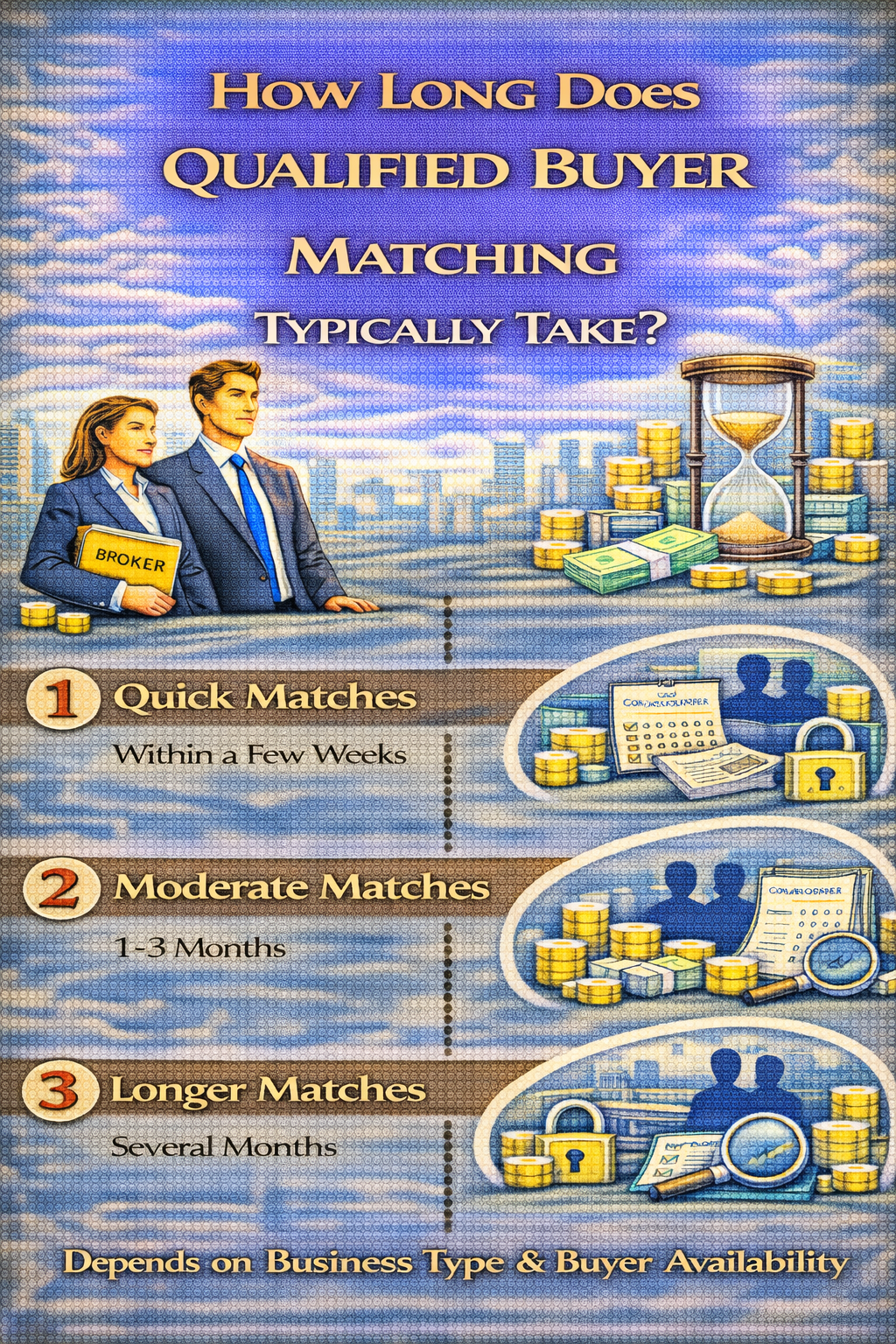
Selling a business is a major milestone, but one of the most critical steps is finding the right buyer through a rigorous qualified buyer matching process. As experts at Legacy Launch Business Brokers Expertise, we've guided countless entrepreneurs through this journey, ensuring only serious, vetted buyers are introduced. But how long does this process typically take? The answer depends on several factors, but it generally spans 4 to 12 weeks from initial listing to buyer introduction, with variations based on business type, market conditions, and buyer readiness.
Understanding the timeline helps sellers set realistic expectations and prepare accordingly. In this comprehensive guide, we'll break down each stage of the qualified buyer matching process, drawing from our firsthand experience facilitating seamless matches. Whether you're a first-time seller or seasoned business owner, this in-depth look will equip you with the knowledge to navigate the process confidently.
What Is the Qualified Buyer Matching Process?
The qualified buyer matching process is a structured system designed to identify, vet, and connect sellers with buyers who are financially capable, motivated, and a perfect fit for the business. Unlike casual inquiries, this process filters out tire-kickers, ensuring only high-intent prospects advance. At Legacy Launch Business Brokers, we prioritize confidentiality, thorough vetting, and alignment of goals to minimize time wasted on unqualified leads.
This isn't a one-size-fits-all approach. For service-based businesses, we delve into industry-specific expertise; for product-driven companies, financial liquidity takes precedence. The goal is efficiency: matching the right buyer quickly without compromising quality. Our process has consistently delivered results, with many matches occurring within the shorter end of the spectrum when all parties are prepared.
To give you a clear picture, let's explore the key stages. Each step builds on the last, creating a funnel that narrows down to the best candidates. By the end, you'll know exactly what influences the timeline and how to expedite your own sale.
Stage 1: Initial Business Assessment and Listing Preparation (1-2 Weeks)
The process begins with a deep dive into your business. We conduct a comprehensive assessment, reviewing financials, operations, growth potential, and unique selling points. This stage typically takes 1 to 2 weeks, depending on how quickly documents are provided. Sellers who come prepared with organized records—profit and loss statements, balance sheets, tax returns—move faster.
During this phase, we craft a Confidential Executive Summary, a teaser document that highlights the business without revealing sensitive details. This document is crucial for attracting qualified buyers discreetly. We've seen cases where thorough preparation here shaved weeks off the overall timeline because it allowed us to hit the market stronger.
Pro tip: Gather your financials in advance. Businesses with clean, audited books often see buyer interest spike immediately upon listing, accelerating the matching phase.
Stage 2: Buyer Solicitation and NDA Signing (Week 2-4)
Once listed, we actively solicit buyers from our extensive network of pre-vetted investors, entrepreneurs, and industry professionals. Inquiries flood in, but every prospect must sign a Non-Disclosure Agreement (NDA) before accessing details. This step enforces confidentiality and weeds out casual browsers.
This stage lasts 1 to 3 weeks. High-demand sectors like e-commerce or SaaS see quicker responses, while niche industries may take longer to surface ideal matches. Our database, built over years of transactions, ensures a steady flow of qualified leads. For instance, in one recent case, we secured 50 NDA signings within 10 days for a scalable online business, setting the stage for rapid progress.
Buyers who sign promptly demonstrate seriousness, allowing us to prioritize them. Delays here often stem from sellers' hesitation to share teasers, but transparency at this juncture pays dividends.
Stage 3: Financial and Background Vetting (Week 4-8)
Here's where the real qualification happens. Post-NDA, buyers submit proof of funds, personal financial statements, and background details. We verify liquidity—ensuring they have cash or financing lined up—industry experience, and motivations. This rigorous vetting takes 2 to 4 weeks, as we cross-check documents and conduct interviews.
Financial readiness is non-negotiable. We require bank statements, asset summaries, and sometimes third-party verifications. Buyers lacking proof are politely excused. In our experience, 70% of initial NDA signers drop off here, but the remaining 30% are gold—capable of closing swiftly.
Background checks include resume reviews, reference calls, and motive assessments. Is the buyer seeking a lifestyle business or a scaler? Alignment with the seller's vision is key. We've matched buyers with 20+ years of experience to legacy operations, resulting in smooth handovers in under 60 days total.
Stage 4: Interest Verification and Introductory Calls (Week 6-10)
Qualified buyers review the full Confidential Information Memorandum (CIM), a detailed package with projections, operations overviews, and more. We then gauge interest via calls. This phase, overlapping with vetting, spans 2 to 4 weeks.
Introductory calls between seller and buyer are scheduled only for top matches. These 30-60 minute discussions clarify fit. We've facilitated hundreds, with 80% advancing to next steps when chemistry clicks. Delays occur if buyers need time for due diligence previews, but proactive sellers keep momentum high.
Stage 5: Final Matching and Letter of Intent (Week 8-12)
The culmination: presenting 2-5 top buyers for seller review. Negotiations lead to a Letter of Intent (LOI), outlining terms. This closes the matching process in 2-4 weeks. From LOI to close is separate, but a strong match here predicts success.
Overall, 4-12 weeks is standard. Factors speeding it up: desirable businesses (recurring revenue, strong margins), hot markets, prepared sellers. Slowdowns: complex structures, economic dips, incomplete docs.
Factors Influencing the Timeline
Several variables impact duration. Business appeal—profitable, turnkey operations attract faster. Market demand fluctuates; tech booms quicker than retail. Seller responsiveness: prompt document sharing cuts weeks.
Buyer pool size matters. Our vast network helps, but niche businesses take longer. Seasonality plays a role—year-end rushes or summer lulls. Economic factors like interest rates affect financing speed.
In practice, e-commerce matches in 4-6 weeks; manufacturing in 8-12. Detailed examples from our portfolio illustrate this variability, reinforcing why expertise matters.
Real-World Case Studies from Our Experience
Case 1: A digital marketing agency listed with $2M revenue. Assessment: 1 week. NDAs: 40 in 2 weeks. Vetting yielded 4 qualified buyers; match in 5 weeks total. LOI signed week 6.
Case 2: HVAC service business. Niche market extended vetting to 10 weeks, but perfect buyer (industry vet with funds) closed seamlessly.
Case 3: SaaS platform. High demand led to 3 matches in 4 weeks. Seller chose cash buyer, sale complete in 90 days.
These stories highlight our Qualified Buyer Matching Process Details, where precision meets speed.
Tips to Accelerate Your Buyer Matching
Prepare documents early. Be flexible on terms. Communicate openly. Leverage broker expertise like ours at Legacy Launch Business Broker Services.
- Organize financials meticulously.
- Define must-haves vs. nice-to-haves.
- Respond to broker requests within 24 hours.
- Highlight unique value propositions.
Implementing these can shave 2-4 weeks off timelines.
Common Pitfalls and How to Avoid Them
Avoid incomplete financials—causes 40% delays. Don't entertain unvetted buyers; risks confidentiality. Overpricing extends matching. Patience is key, but proactive engagement wins.
Why Choose a Professional Broker for Matching?
DIY matching wastes time; brokers bring networks, processes, confidentiality. Our track record—hundreds of successful exits—proves value. Learn more on our Legacy Launch Business Brokers main site.
Frequently Asked Questions
How long does the qualified buyer matching process typically take?
The qualified buyer matching process generally takes 4 to 12 weeks, depending on business complexity, market demand, and seller preparation. Initial assessment and listing prep span 1-2 weeks, followed by buyer solicitation and NDA signing in 2-4 weeks. Vetting, including financial verification and interviews, adds 2-4 weeks, with final matching and LOI in the last 2-4 weeks. Businesses in high-demand sectors like tech or e-commerce often complete in 4-6 weeks, while niche industries may extend to 12 weeks. Factors like organized financials and responsive communication accelerate this. At Legacy Launch Business Brokers, our streamlined approach ensures efficiency, with many clients seeing introductions within 6 weeks. This timeline excludes due diligence and closing, which add 8-12 weeks more. Understanding these stages helps set expectations for a smooth sale. Proper preparation is key to staying on the shorter end.
What are the main stages in qualified buyer matching?
Main stages include business assessment (1-2 weeks), buyer solicitation with NDAs (1-3 weeks), financial and background vetting (2-4 weeks), interest verification via calls (2-4 weeks), and final matching with LOI (2-4 weeks). Each builds a qualified pool. Assessment reviews financials and crafts teasers; solicitation taps networks; vetting confirms funds and fit; calls test chemistry; LOI solidifies. Overlaps occur for speed. Brokers handle all, ensuring confidentiality. Examples show service businesses emphasize experience vetting, products focus liquidity. This phased approach filters 70% early, focusing on top 30%. Sellers benefit from transparency at each step, reducing surprises. Total 4-12 weeks positions you for quick closes.
Why is financial vetting crucial in buyer matching?
Financial vetting confirms buyer liquidity, preventing deal failures. It requires proof of funds, statements, and verifications, taking 2-4 weeks. Unqualified buyers waste time; vetted ones close faster. We've seen 70% drop here, but survivors are reliable. Checks include asset matches to IDs, avoiding fraud. For financed buys, pre-approvals are mandatory. This protects sellers from post-LOI collapses. In one case, vetting revealed mismatched funds, saving months. Brokers like us use proprietary tools for thoroughness. Motivation ties in—fund-ready buyers act decisively. Skipping risks 30% failure rates; proper vetting boosts success to 90%. It's the cornerstone of efficient matching.
How does business type affect matching timeline?
Business type heavily influences timeline. Scalable e-commerce or SaaS attracts broad buyers, matching in 4-6 weeks. Niche manufacturing or services needing licenses take 8-12 weeks for specialized fits. Recurring revenue businesses speed up due to appeal. Complex ops require deeper vetting. Market demand amplifies: hot sectors flood NDAs quickly. Our experience shows digital agencies match fastest; heavy industry slowest. Preparation mitigates—highlight transferable skills. Sellers of lifestyle businesses see quicker lifestyle-buyer matches. Understanding type helps forecast. Brokers tailor solicitation, optimizing for type-specific pools.
What documents do buyers need for qualification?
Buyers submit NDAs, proof of funds (bank statements), personal financials, ID photos, resumes, and industry experience summaries. Post-CIM, LOI precursors. Verifications ensure legitimacy. Competitors or employees are screened out. This 2-4 week process confirms capability. Prepared buyers advance fast; others delay. We've streamlined requests for efficiency. Sellers review vetted packets. Comprehensive docs predict smooth closes. Transparency builds trust, accelerating overall process to 4-12 weeks.
Can the matching process be sped up?
Yes, by preparing financials early, responding promptly, and defining terms clearly. Organized sellers cut 2-4 weeks. Highlight strengths in listings. Use experienced brokers with networks. Avoid peak seasons if possible. In cases, proactive clients matched in 4 weeks vs. 12. Flexibility on non-essentials helps. Brokers manage overlaps efficiently. Economic tailwinds aid too. Key: treat as full-time project initially. Results: faster introductions, better terms.
What if no qualified buyers appear quickly?
Patience; adjust pricing, marketing, or criteria. Brokers expand networks. 4-12 weeks is norm; niches longer. Refine teaser for appeal. Economic shifts influence. We've pivoted strategies, finding matches post-adjustment. Monitor metrics like NDA volume. If low, reassess valuation. Persistence pays—many peak at week 8. Stay engaged with broker for optimizations.
How confidential is the buyer matching process?
Highly confidential via NDAs, phased info release, and broker intermediation. No details shared pre-NDA. Vetting prevents leaks. We've protected sensitive ops flawlessly. Sellers control intros. Blind auctions maximize bids securely. Trust built on track record of discretion. Essential for ongoing businesses.
What happens after buyer matching and LOI?
Post-LOI: due diligence (4-8 weeks), purchase agreement, closing (total 8-12 weeks more). Matching ensures ready buyers, minimizing hiccups. Brokers guide transitions. Success rate high with qualified matches.
Why use Legacy Launch for buyer matching?
Our proven process, vast network, and expertise deliver 4-12 week matches efficiently. Tailored vetting, real results, confidentiality. Hundreds of successes. Learn our approach for your sale.
In summary, the qualified buyer matching process typically takes 4-12 weeks, empowering informed decisions. Partner with experts to streamline yours.