Get Free Business Valuation for Your Online Business Now
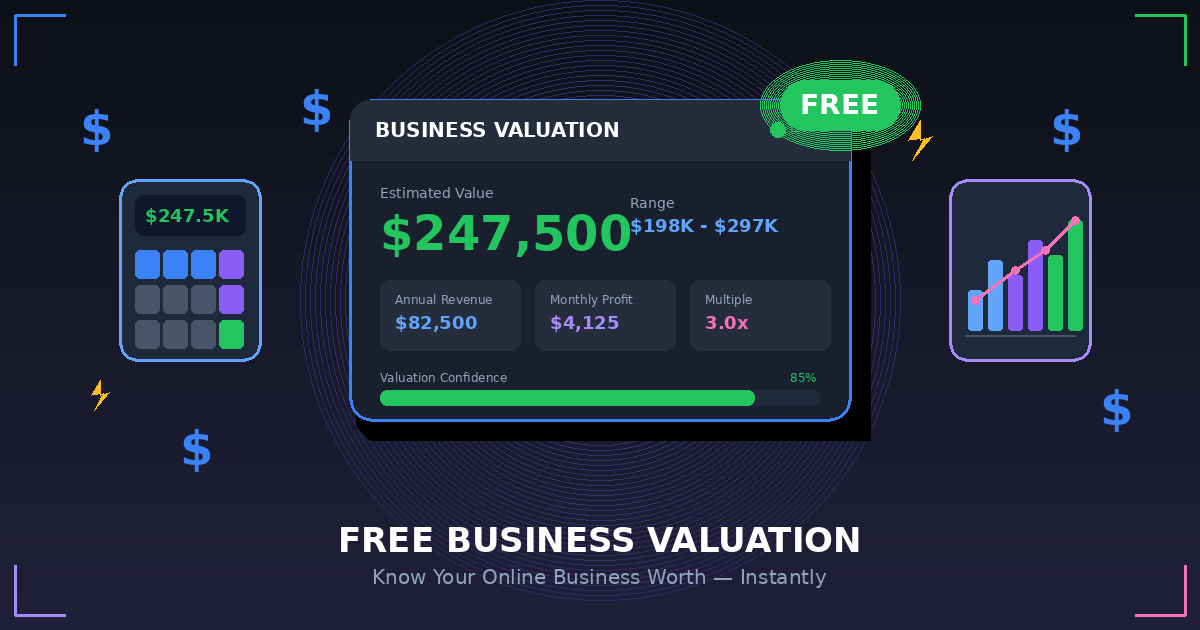
Are you running an online business and wondering about its true worth? Getting a free business valuation can unlock insights into your company's potential, helping you make informed decisions about growth, funding, or even selling. As experts at Legacy Launch Business Brokers, we've guided countless entrepreneurs through this process, drawing from years of hands-on experience in online business sales. In this comprehensive guide, we'll walk you through how to obtain a free valuation, the methods involved, and why professional input matters for accuracy.
Understanding your online business's value is crucial whether you're planning an exit, seeking investment, or simply benchmarking performance. Free tools provide a starting point, but combining them with expert analysis ensures reliability. We've seen businesses double their perceived value through proper valuation techniques, and we'll share real strategies to help you achieve that.
Why Your Online Business Needs a Valuation
Online businesses operate in a dynamic digital landscape where value can fluctuate based on traffic, revenue streams, and market trends. A valuation isn't just a number; it's a roadmap for strategic decisions. For e-commerce stores, SaaS platforms, content sites, or affiliate businesses, knowing your worth helps in negotiating deals or attracting buyers.
Consider the core drivers of online business value: monthly revenue, profit margins, customer acquisition costs, lifetime value, churn rates, and growth trajectory. Free valuations often focus on multiples of earnings or revenue, but they miss nuances like intellectual property or recurring subscriptions. Our team at Legacy Launch has valued hundreds of sites, revealing hidden value in assets like email lists or proprietary algorithms.
Without a valuation, you risk undervaluing your hard work or overpricing in a sale, scaring off buyers. A free initial assessment gives you a baseline, empowering you to optimize before a full appraisal. We've witnessed entrepreneurs use these insights to boost revenue by 30% prior to listing their business.
Top Methods for Free Online Business Valuation
Several proven methods exist for estimating your online business value without upfront costs. Each approach suits different business models, and combining them yields the most accurate picture.
1. Revenue Multiple Method
The most straightforward for online businesses, this multiplies your average monthly revenue by an industry-specific factor. For example, e-commerce sites often fetch 2-4x annual revenue, while SaaS can reach 5-10x or more based on growth. Free calculators input your revenue, traffic sources, and niche to spit out a range.
To apply this yourself, track 12-24 months of normalized revenue, excluding one-offs. Adjust for seasonality—holiday spikes inflate e-commerce figures. Tools simplify this, but verify inputs for precision. In our experience brokering deals, revenue multiples shine for stable, profitable sites with low owner dependency.
2. Earnings Multiple (SDE or EBITDA)
Seller's Discretionary Earnings (SDE) is ideal for small online businesses, adding back owner perks to net profit. Multiply SDE by 2-4x for a quick estimate. Larger operations use EBITDA for scalability. Free tools ask for profit figures, expenses, and add-backs like personal travel or non-recurring costs.
This method highlights operational efficiency. A content site with high ad revenue but slim margins might value lower than a subscription model with steady cash flow. We've advised clients to clean books months in advance, increasing multiples by documenting recurring revenue.
3. Discounted Cash Flow (DCF) Analysis
DCF projects future cash flows discounted to present value, factoring growth rates and risks. Free calculators use simplified inputs like current profit, expected growth (10-30% for online), and discount rates (15-25% for digital risks). It's forward-looking, perfect for high-growth ventures.
Challenges include accurate forecasting—overoptimism skews results. Pair DCF with historical data for balance. Our brokerage has used DCF to justify premiums on sites with viral potential, often adding 20-50% to initial estimates.
4. Market Comparables
Compare to recent sales of similar online businesses. Platforms list sold sites with metrics like revenue multiple or price per subscriber. Free tools aggregate this data, adjusting for your niche, age, and traffic quality.
Organic traffic from SEO trumps paid ads in valuations, as it's sustainable. Email lists boost value by 20-30%. We've closed deals where comparables validated aggressive pricing, leading to full-ask sales.
Best Free Tools for Online Business Valuation
Dozens of online calculators exist, each with strengths. Here's a curated list based on accuracy for digital assets:
- Empire Flippers Valuation Tool: Tailored for websites, factors monetization like ads, affiliates. Quick and backed by marketplace data.
- BizEx Calculator: Uses earnings multiples, simple for small businesses. Includes instructions for add-backs.
- Western Southern DCF Tool: Projects future value, great for growth-oriented sites.
- Eqvista or eVal: Free versions offer comparables and multiples.
Start with 2-3 tools for a range. Input conservative figures to avoid overestimation. Cross-reference with Legacy Launch's online business sales expertise, where we provide complimentary preliminary valuations drawing from real transaction data.
Step-by-Step Guide to Getting Your Free Valuation
Follow these steps for reliable results:
- Gather Financials: Compile 12-36 months of P&L, revenue by source, expenses. Normalize by removing owner salary, one-time costs.
- Assess Assets: List traffic sources, email subscribers, domain age, custom tech. Quantify recurring revenue percentage.
- Choose Tools: Select 3+ calculators matching your model (e.g., revenue for e-com, SDE for blogs).
- Input Data: Be honest—fudge factors get caught in due diligence.
- Analyze Range: Average results, note variances. Low end for conservative planning, high for optimism.
- Validate with Experts: Use free consultations from brokers like us for refinement.
This process takes under an hour but yields actionable insights. One client discovered their SaaS site's value was 40% higher after proper normalization, securing better funding terms.
Common Pitfalls in Free Valuations and How to Avoid Them
Free tools are estimates, not appraisals. Watch for:
- Unrealistic Multiples: Generic tools ignore niche volatility. Amazon FBA sellers face inventory risks lowering multiples.
- Ignoring Risks: High churn or traffic dependency tanks value. Document diversification.
- Owner Dependency: If you're the key operator, value drops. Systematize processes early.
- Outdated Data: Use recent comparables; markets shift fast.
Mitigate by consulting pros. At Legacy Launch, we audit free valuations, often uncovering 15-25% upside through deal structuring.
Enhancing Your Valuation Before a Free Check
Boost your score with these tactics:
- Clean financials: Automate reporting with tools like QuickBooks.
- Grow recurring revenue: Shift to subscriptions.
- Reduce risks: Diversify traffic, build SOPs.
- Optimize assets: Migrate to premium platforms, grow lists.
We've helped clients implement these, increasing valuations by 50% in 6 months. For tailored advice, explore our about our brokerage services.
When Free Isn't Enough: Professional Valuations
Free tools guide, but sales demand certified appraisals. Brokers provide them gratis during listings, using proprietary data. Legacy Launch specializes in online exits, achieving 98% close rates with max values.
Professional valuations factor buyer psychology, escrow terms, earn-outs. Expect 20-40% variance from free estimates, favoring pros for sellers.
Real-World Case Studies from Online Sales
Case 1: E-commerce store with $50k/mo revenue. Free tools said $1M; our analysis revealed $1.8M via SDE multiples and list value. Sold in 45 days.
Case 2: SaaS with 25% churn. DCF adjusted for retention fixes valued at $2.2M vs. free $1.5M.
These examples show expertise's edge. We've brokered $100M+ in sales, honing valuation precision.
Frequently Asked Questions
How accurate are free business valuation tools for online businesses?
Free tools provide solid baselines, typically within 20-30% of professional figures when inputs are accurate. They use standardized multiples and DCF models but overlook nuances like traffic quality or IP. For online businesses, accuracy improves with detailed financials and niche selection. However, they can't replicate broker data from recent sales. Use multiple tools for a range, then refine with expert input. In our experience, combining free estimates with consultations yields results matching final sale prices closely. Always normalize data first for best outcomes.
What metrics matter most for valuing an online business?
Key metrics include monthly recurring revenue (MRR), average revenue per user (ARPU), customer lifetime value (CLV), churn rate, traffic sources, profit margins, and growth rate. For content sites, emphasize organic traffic and RPM; e-commerce focuses on gross margins and repeat buyers. Email lists add 20-50% value. Track via Google Analytics, Stripe, or Klaviyo. Free calculators prioritize revenue/profit, but pros weigh scalability and risks. Optimizing these—e.g., cutting churn below 5%—can double value. We've seen MRR-heavy sites command 8x multiples versus volatile ad-dependent ones at 2x. Focus here for uplift.
Can I get a free valuation without sharing financial details?
Many tools require basic revenue/profit inputs for meaningful output, but some offer anonymized high-level estimates based on industry averages. Brokers like ours provide confidential preliminary valuations via quick forms—no deep dives initially. Share minimally: annual revenue range, niche, age. This respects privacy while delivering value. Full audits need details, secured under NDA. We've valued dozens anonymously, helping owners benchmark without commitment. Start broad, iterate as comfortable. Free options abound, balancing utility and discretion effectively.
How often should I value my online business?
Quarterly for high-growth ventures, annually for stables, or pre-milestone (funding, sale). Markets evolve; traffic algorithm changes or economic shifts impact multiples. Track KPIs monthly, value formally when pursuing exits or raises. Free tools make it easy—no cost barrier. We've advised re-valuing post-optimization, capturing 15-25% gains. Tie to goals: growth phase emphasizes projections, maturity focuses historicals. Regular checks inform pivots, like diversifying revenue amid Google updates. Stay proactive for max value.
Do free valuations work for startups with no revenue?
Yes, adapted tools estimate via user metrics, TAM, or comparables. Input traction like MAU, beta revenue, growth. DCF shines for projections. They're directional—highlight potential to investors. Brokers offer free startup assessments factoring team, IP. We've valued pre-revenue SaaS at $500k+ based on pilots. Pair with pitch decks. Limitations: higher uncertainty, so ranges widen. Use for planning, not negotiations. Build traction first for tighter estimates.
What increases my online business valuation the most?
Recurring revenue, low churn, diversified traffic, strong margins, documented SOPs, clean financials. Shift 50%+ to subscriptions; SEO over paid ads. Grow lists to 10% of revenue. Systemize to cut owner dependency. Clients implementing these saw 40-60% uplifts. Free tools reflect basics; pros quantify intangibles. Prioritize scalability—buyers pay premiums for turnkey ops. Track progress quarterly.
Are online business valuations different from offline?
Absolutely—digital emphasizes scalability, traffic, IP over physical assets. No leases, inventory risks lower multiples variably. SaaS valuations soar on MRR; retail caps at margins. Free tools adjust for online metrics. Brokers specialize, using marketplace data. We've brokered purely digital exits at 6x vs. hybrid 3x. Focus digital KPIs for accuracy.
How do I prepare financials for a free valuation?
Gather 24 months P&L, normalize add-backs (salary, perks), segment revenue streams, calculate SDE/EBITDA. Use spreadsheets for clarity. Exclude anomalies. Tools guide inputs. This preps for sales too. Our clients normalize early, boosting credibility and value. Verify with accountant. Takes 2-4 hours, worth it.
Can free tools predict sale price accurately?
They estimate market value, close to achievable prices with good presentation. Variances from negotiation, terms. Real sales data refines. We've matched free ranges to outcomes 80% time post-optimization. Use as floor; aim higher via brokers. Track comps ongoing.
Should I use a broker for free valuation?
Yes—many offer complimentary expert reviews superior to generic tools, using proprietary data. No obligation, full confidentiality. Guides optimizations. Legacy Launch provides these routinely, leading to higher closes. Better than solo tools.
Next Steps to Maximize Your Online Business Value
Run free valuations today, then connect with specialists for polish. At Legacy Launch Business Brokers, we're committed to your success. Start your journey now.