Determining the cost of acquisitions advisory services is a critical step for any business owner or executive planning to expand through strategic purchases. These fees can vary widely based on deal size, complexity, and the scope of services provided, but understanding the typical structures empowers informed decision-making. In this comprehensive guide, we break down everything you need to know about acquisitions advisory costs, drawing from industry standards and real-world examples to provide clarity and value.
At Legacy Launch Business Brokers: Expert M&A Guidance, we specialize in guiding clients through the acquisition process with transparency and expertise. Whether you're targeting small businesses or larger opportunities, knowing what to expect in terms of fees ensures you select the right partner without surprises.
What Are Acquisitions Advisory Services?
Acquisitions advisory involves expert guidance for companies looking to buy other businesses. Advisors assist with target identification, due diligence, valuation, negotiation, and closing the deal. Unlike sell-side services focused on exiting, buy-side acquisitions advisory emphasizes finding and securing the best acquisition targets to fuel growth.
These services are invaluable for businesses seeking to scale quickly, enter new markets, or acquire talent and technology. The process typically spans several months, involving market research, financial analysis, and legal structuring. Costs reflect the high level of customization and the advisor's network of potential targets.
Key components include initial consultations to define acquisition criteria, sourcing qualified targets, preparing offers, and managing negotiations. Experienced advisors like those at Legacy Launch Business Brokers bring proprietary deal flow and industry insights that accelerate success.
Why Do Acquisitions Advisory Fees Vary So Much?
Fee structures for acquisitions advisory costs depend on multiple factors. Deal size is primary: smaller transactions under $1 million often command higher percentage fees due to the intensive effort required relative to the value. Larger deals over $50 million shift toward fixed fees or lower percentages because the absolute dollar amounts are substantial.
Complexity plays a role too. Deals in regulated industries like healthcare or tech involve more due diligence, increasing costs. Advisor expertise matters—boutique firms with niche knowledge may charge premiums over generalists. Engagement length, typically 6-12 months, influences retainers.
Market conditions affect pricing. In competitive buyer's markets, advisors might offer flexible terms to win mandates. Economic downturns can lead to higher retainers as advisors cover opportunity costs. Success fees, paid only upon closing, align incentives but vary by risk level.
Typical Fee Structures for Acquisitions Advisory
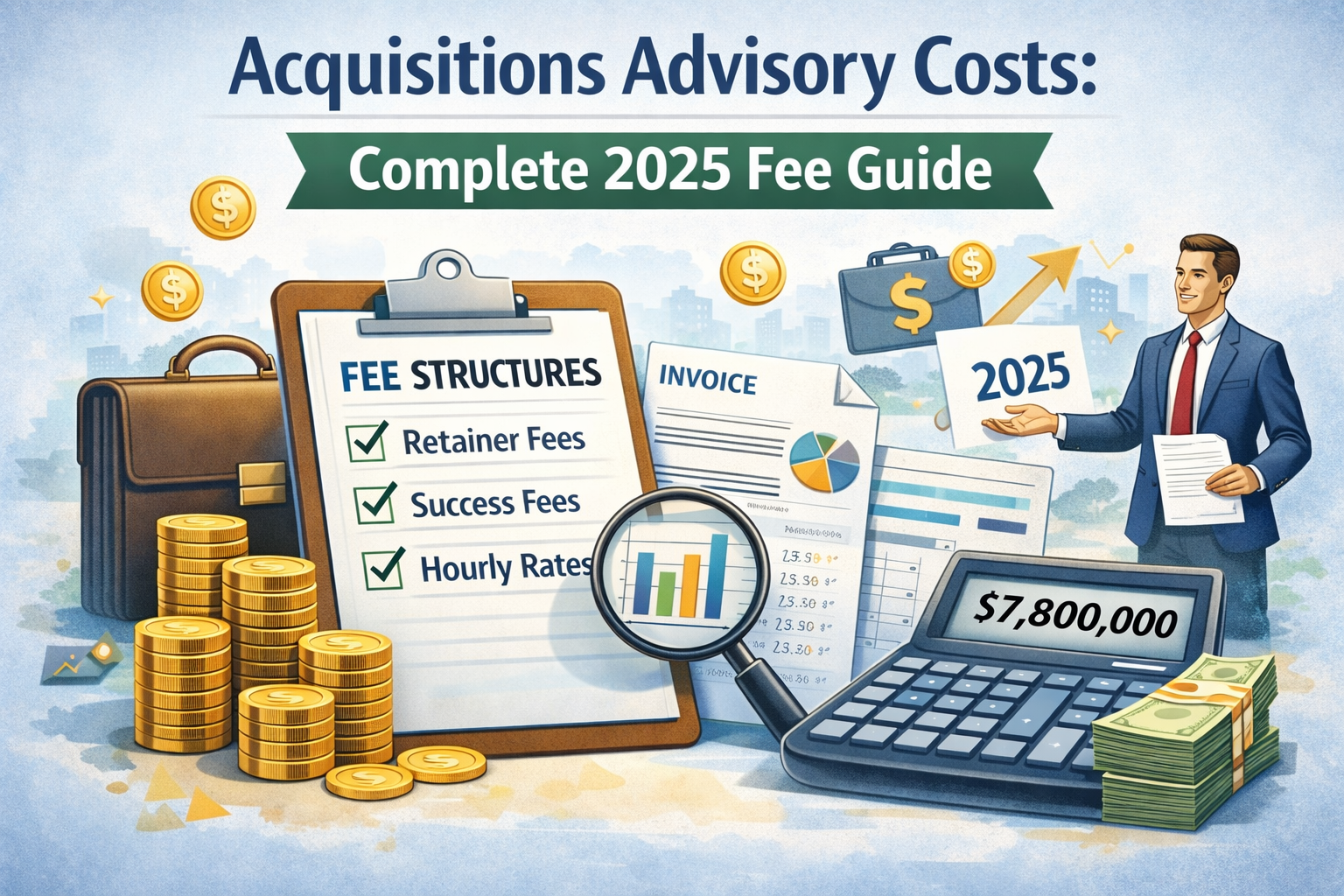
Most acquisitions advisory engagements use a hybrid model: retainer plus success fee. Retainers ensure commitment and cover initial work like target screening. Success fees, contingent on deal completion, form the bulk of compensation.
- Retainer Fees: Monthly payments ranging from $5,000 to $50,000, depending on deal scale. For sub-$1M deals, expect $5k-$10k/month; mid-market $10k+.
- Success Fees: 1%-10% of transaction value, scaling inversely with size. Small deals: 5-10%; large: 1-3%.
- Fixed Fees: Less common for buy-side, but used for defined scopes like valuation ($10k-$50k).
- Expense Reimbursements: Travel, legal reviews—typically capped.
This structure motivates advisors to deliver results while providing upfront resources.
Acquisitions Advisory Costs by Deal Size
Here's a detailed breakdown based on industry data for 2025:
Deal SizeMonthly RetainerSuccess Fee %Total Estimated Fee<$1M$5k-$10k7-10%$50k-$75k$1-10M$10k-$20k5-8%$75k-$200k$10-30M$15k-$30k3-6%$200k-$500k$30-50M$20k-$40k2-5%$500k-$750k$50M+$25k-$50k1-3%$750k+
For a $5M acquisition, total costs might hit $250k-$400k, including 6 months retainer (~$75k) plus 5% success ($250k). Larger deals see economies of scale.
Detailed Breakdown of Retainer Fees
Retainers secure the advisor's full attention. For buy-side work, they fund target searches, which can involve reviewing hundreds of opportunities. Typical ranges:
- Small deals: $45k-$55k total retainer over engagement.
- Mid-market: $56k-$150k, often monthly.
Some advisors credit retainers against success fees, reducing net cost if the deal closes. Negotiate milestones for partial refunds if no deal materializes within timelines.
Understanding Success Fees in Depth
Success fees are the headline number, calculated on enterprise value or purchase price. Lehman Formula is common for mid-market: 5% on first $1M, 4% on second, etc., tapering down. Double Lehman doubles these for complex deals.
Example: $5M deal under Lehman = 5%*$1M + 4%*$1M + 3%*$1M + 2%*$1M + 1%*$1M = $250k. Advisors justify tiers by front-loaded work on smaller portions.
Buy-side fees trend lower (0.5-2%) than sell-side (3-10%) since advisors source deals without marketing costs. Always clarify if fees apply to gross or net proceeds.
Additional Costs to Budget For
Beyond core fees, expect:
- Due Diligence: $20k-$100k for legal, financial audits.
- Valuations: $5k-$20k.
- Travel/Expenses: $10k-$30k, reimbursable.
- Legal/Financing: 1-2% of deal value separately.
Total all-in costs can reach 2-5% of deal value. Factor these into ROI calculations early.
How Legacy Launch Business Brokers Approaches Acquisitions Advisory Costs
Our Acquisitions Advisory Services: Tailored Buy-Side Solutions emphasize value-driven pricing. We structure fees to align with client goals, offering competitive retainers and performance-based success tiers. With proven expertise in mid-market deals, we minimize risks and maximize outcomes.
Explore our methodologies on our Comprehensive Business Brokerage Services Overview, where we detail full-spectrum support from advisory to closing.
Real-World Examples of Acquisitions Advisory Costs
Consider a $2M software firm acquisition: Retainer $15k/month for 8 months ($120k), success 6% ($120k), total $240k. The advisor identified 50 targets, diligenced 5, closed one—ROI justified by synergies worth millions.
For a $25M manufacturing buy: $25k/month retainer (9 months, $225k), 4% success ($1M), total ~$1.225M. Expertise in sector navigated regulatory hurdles, saving months.
These cases illustrate how fees translate to tangible value, often paying for themselves in deal quality and speed.
Negotiating Acquisitions Advisory Fees Effectively
Approach negotiations strategically:
- Compare Quotes: Get 3-5 proposals, benchmark against industry tables.
- Cap Fees: Set maximum success fee or total compensation.
- Tiered Success: Lower % for higher values.
- Exclusivity: Shorter terms reduce retainers.
- Performance Metrics: Tie payments to milestones like targets sourced.
Strong advisors welcome negotiation—it signals serious buyers.
Common Pitfalls in Managing Acquisitions Advisory Costs
Avoid these traps:
- No Clear Scope: Undefined work leads to scope creep.
- Ignoring Expenses: Uncapped reimbursables inflate bills.
- Premature Commitments: Long exclusivities without progress.
- Fee Misalignment: Hourly add-ons erode success incentives.
Insist on detailed contracts outlining all terms.
Trends Impacting Acquisitions Advisory Costs in 2025
Recent shifts include:
- Higher retainers (16% firms at $16k+/month) due to talent costs.
- Declining success % for small deals (5.5% to 4.8% for $5M).
- Rise of fixed fees for larger deals ($1-3M).
- Tech-enabled efficiency lowering some costs.
Buy-side focus grows as PE firms seek platforms.
Is Acquisitions Advisory Worth the Cost?
Absolutely, for most. Advisors access off-market deals (70% of transactions), reduce risk via diligence, and boost close rates from 20% DIY to 80%+. Net savings from avoided mistakes often exceed fees 5-10x.
DIY works for tiny deals but scales poorly.
When to Hire an Acquisitions Advisor
Ideal if: first-time buyer, complex targets, time-constrained, or scaling aggressively. Skip for simple asset purchases.
Choosing the Right Acquisitions Advisor
Evaluate: track record, sector focus, network size, references, fee transparency. Boutique firms excel in mid-market personalization.
Frequently Asked Questions
How much does acquisitions advisory typically cost for small deals under $1M?
For small deals under $1 million, acquisitions advisory costs usually include a monthly retainer of $5,000 to $10,000 over 6-12 months, totaling $30,000 to $120,000 upfront. Success fees range from 7% to 10% of the transaction value, adding $70,000 to $100,000 upon closing. Total costs often fall between $50,000 and $75,000 for straightforward acquisitions. These higher percentages account for the intensive work relative to deal size, including sourcing limited targets and thorough due diligence. Factors like industry complexity can push fees higher, but many advisors credit retainers against success fees, effectively lowering net costs. Always negotiate caps and milestones to control expenses. Experienced firms demonstrate value through faster closes and better terms, justifying the investment for growth-focused buyers. Compare structures to ensure alignment with your budget and timeline.
What is the average success fee percentage for acquisitions advisory?
The average success fee for acquisitions advisory ranges from 1% to 5% of the transaction value, varying inversely with deal size. Smaller deals (<$10M) see 5-10%, mid-market ($10-50M) 2-6%, and large ($50M+) 1-3%. This structure, often using Lehman tiers (e.g., 5% first $1M, tapering to 1%), reflects effort distribution. Buy-side fees trend lower than sell-side due to no marketing costs. In 2025 data, $5M deals average 4.8%, $20M at 3.4%. Negotiate based on advisor network strength and deal risk. Fixed success fees emerge for larger deals ($1-3M flat). Clarity on calculation base (enterprise vs. equity value) prevents disputes. Strong advisors earn fees via exclusive opportunities and negotiation leverage, delivering ROI far exceeding costs. Review contracts for adjustments like earn-outs.
Are there retainer fees in acquisitions advisory services?
Yes, retainer fees are standard in acquisitions advisory costs, typically $5,000-$50,000 monthly for 3-12 months. Small deals: $5k-$10k/month; mid-market: $15k-$30k. Total retainers range $45k-$150k, funding target sourcing and analysis. Many are creditable against success fees, reducing effective cost if closed. Boutique firms charge higher for specialized access. Negotiate minimum terms (e.g., 6 months) and refund clauses for non-performance. Expenses like travel are separate but capped. Retainers align incentives, ensuring dedicated effort amid multiple mandates. In competitive markets, flexible retainers attract top advisors. Budget 20-30% of total projected fees for retainers. Verify advisor methodologies to confirm value delivery. This upfront commitment separates serious engagements from speculative ones, accelerating deal timelines.
How do buy-side vs. sell-side advisory fees compare?
Buy-side acquisitions advisory costs (0.5-2% success fees) are lower than sell-side (3-10%), as buy-side skips marketing and auction processes. Buy-side retainers ($25k-$100k/month) mirror sell-side but focus on sourcing. Sell-side emphasizes valuation and buyer outreach, justifying higher % via broader efforts. For $10M deals, buy-side total ~$200k-$400k vs. sell-side $500k+. Buy-side ROI stems from optimal targets; sell-side from max price. Hybrid firms like Legacy Launch handle both efficiently. Trends show buy-side rising with PE activity. Evaluate based on your role—acquirers prioritize network depth, sellers process rigor. Negotiate accordingly for balanced economics. Understanding differences aids partner selection and fee benchmarking.
What factors influence acquisitions advisory fee structures?
Several factors shape acquisitions advisory costs: deal size (inverse scaling), complexity (regulated sectors +20-50%), advisor reputation (boutiques premium), engagement scope (full vs. targeted +retainer), market conditions (hot markets lower %), and timeline (rush fees). EBITDA range dictates tiers: <$1M high %, $50M+ fixed. Industry data shows 2025 shifts to higher retainers amid talent competition. Client leverage from competitive bids reduces rates. Contracts detail adjustments for multiples or earn-outs. Sector expertise commands premiums but delivers better outcomes. Economic cycles impact: downturns raise retainers. Thorough RFPs uncover optimal structures. Prioritize value over lowest fee—strong advisors save multiples via diligence and networks.
Can you negotiate acquisitions advisory fees?
Absolutely, negotiation is expected in acquisitions advisory costs. Strategies include multi-firm RFPs for benchmarking, capping total fees (e.g., 3% max), tiered success (lower for exceeds), crediting full retainers, milestone payments, and shorter exclusives. Offer equity or repeat business for discounts. Highlight your preparedness to strengthen position. Top advisors flexible on structure, rigid on value. Avoid lowballing—undercutting erodes service quality. 2025 data shows 10-20% savings possible via smart talks. Review Lehman variants or fixed alternatives. Insist on transparency in expense caps. Post-negotiation, align on KPIs like targets/month. Successful negotiations balance cost with expertise, ensuring partnership success. References confirm fair deals.
What are hidden costs in acquisitions advisory?
Beyond headline fees, acquisitions advisory costs include due diligence ($20k-$100k), valuations ($5k-$20k), legal/structuring (1-2%), travel ($10k-$30k), and financing fees. Hourly add-ons for extras, uncapped expenses, or post-close integration support add up. Earn-outs inflate if targets outperform. Taxes on fees overlooked. Total all-in 2-5% deal value. Mitigate via detailed LOIs specifying inclusions, caps, and no-surprise clauses. Advisors should itemize. Industry reports note 20-30% budgets overrun sans controls. Budget conservatively, allocate 25% contingency. Value transparency signals trustworthy partners. Track via shared dashboards. Proactive management keeps costs predictable, preserving deal economics.
How long does an acquisitions advisory engagement last?
Typical acquisitions advisory engagements span 6-12 months: 2-4 months sourcing/LOIs, 2-4 diligence/negotiation, 1-2 closing. Complex deals extend to 18 months; simple 4-6. Retainers cover minimums. Milestones accelerate: defined criteria shorten sourcing. Advisor networks impact speed—strong ones close faster. 2025 trends favor tech tools for efficiency. Contracts define phases, exit ramps. Budget for extensions. Success correlates with timeline discipline. Engage early for best flow. Post-close support optional. Realistic expectations prevent frustration, optimize costs.
Do acquisitions advisors guarantee deals close?
No, acquisitions advisory cannot guarantee closes—deals fail on pricing, synergy mismatches, financing (30% cases). Success fees only pay on completion, aligning risks. Advisors boost odds via vetted targets (close rates 70-80% vs. 20% DIY). Track records matter: review past mandates. Contingency clauses protect retainers. Value in process even sans close—refined criteria for future. Industry stats: 40% mandates fail, but lessons compound. Choose based on pipeline strength, not promises. Transparency builds trust.
When is flat fee acquisitions advisory appropriate?
Flat fees suit defined scopes like target lists ($25k-$50k), valuations, or simple deals ($100k-$500k). Ideal for low-complexity, experienced buyers wanting cost certainty. Less common buy-side due to variable sourcing. Larger deals ($50M+) favor $1-3M fixed. Pros: budgeting ease; cons: misaligned incentives. Hybrid best for most. Evaluate scope fit. 2025 rise in fixed for efficiency. Negotiate clearly.
Final Thoughts
Navigating acquisitions advisory costs requires understanding structures, benchmarks, and value drivers. By selecting aligned partners and negotiating smartly, you maximize growth ROI. Contact experts ready to guide your next acquisition.