In the dynamic world of business transactions, understanding the nuances between acquisitions advisory and traditional business brokerage can make all the difference for owners and buyers seeking optimal outcomes. This comprehensive guide breaks down what each service entails, highlights their core differences, and explains why choosing the right partner matters for your next deal.
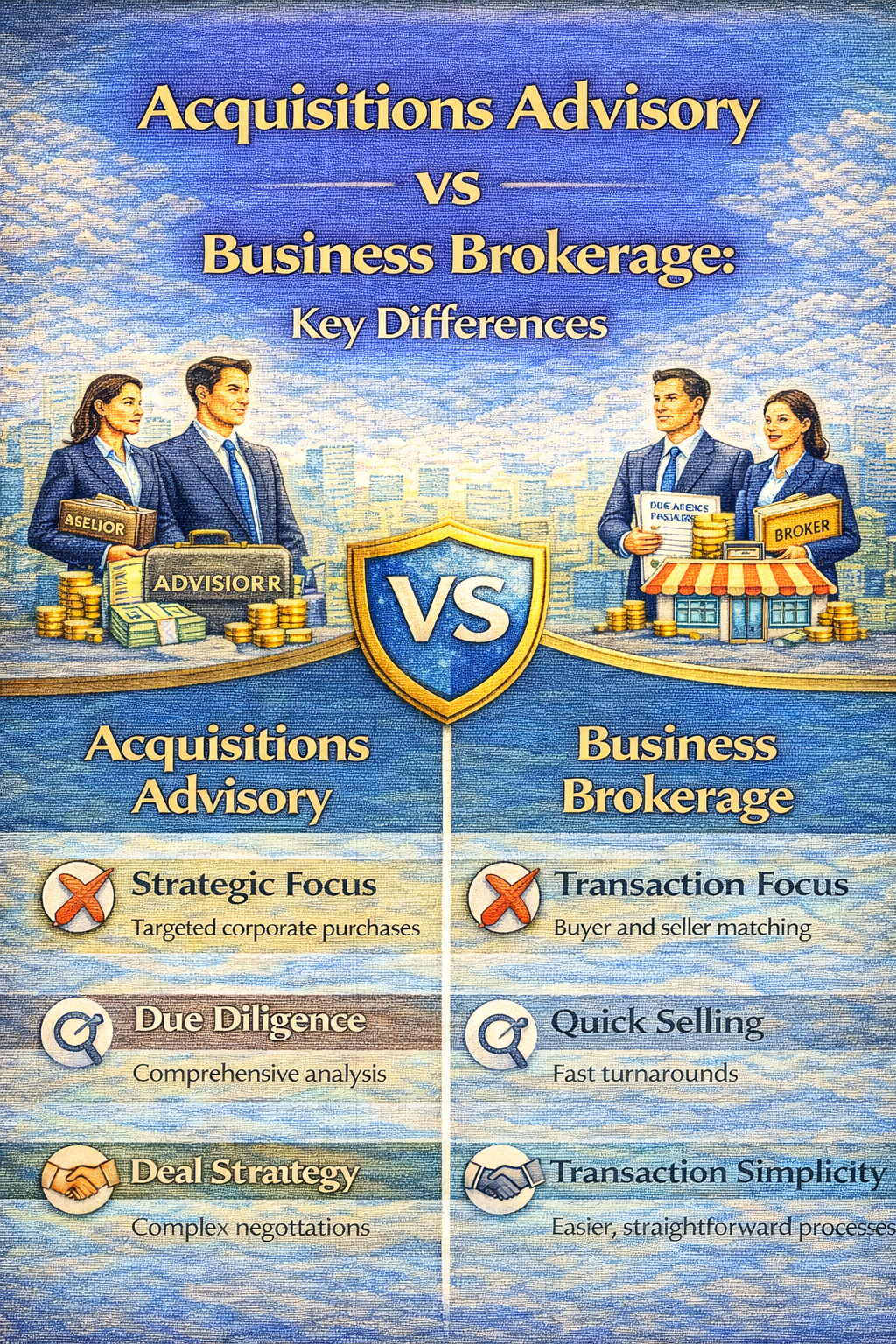
What is Acquisitions Advisory?
Acquisitions advisory represents a sophisticated, strategic approach to business purchases, designed specifically for buyers aiming to expand or enter new markets through targeted acquisitions. Unlike transactional matchmaking, acquisitions advisory encompasses end-to-end guidance, from opportunity identification to post-deal integration. Advisors in this field leverage deep industry networks, proprietary deal flow, and advanced analytical tools to source off-market opportunities that aren't listed on public platforms.
At its core, acquisitions advisory focuses on aligning acquisitions with a buyer's long-term growth strategy. This includes rigorous financial modeling, valuation assessments, and risk mitigation strategies. For instance, advisors conduct thorough due diligence to uncover hidden liabilities, evaluate synergies, and structure deals that maximize value. They often work with mid-market companies, handling transactions valued in the multi-millions, where complexity demands expertise beyond basic facilitation.
One hallmark of effective acquisitions advisory is proactive preparation. Advisors help buyers refine their acquisition criteria, such as revenue thresholds, industry focus, and geographic preferences, before the search begins. This targeted approach reduces time-to-close and increases success rates. Moreover, they provide ongoing support post-acquisition, ensuring smooth transitions, cultural integration, and realization of projected synergies.
Consider a manufacturing firm looking to acquire a complementary supplier. An acquisitions advisor would not only identify suitable targets but also model the financial impact of the merger, negotiate terms, and facilitate integration planning. This holistic service transforms acquisitions from risky gambles into strategic wins.
Understanding Traditional Business Brokerage
Traditional business brokerage, on the other hand, centers on facilitating the sale of smaller, main street businesses—think local retail shops, service providers, or family-owned operations with revenues typically under $5 million. Brokers act as intermediaries, marketing listings to a broad pool of individual buyers, often through online platforms and their personal networks.
The process in business brokerage is more straightforward and transactional. Brokers assist sellers in valuing their business using simplified multiples based on earnings, preparing basic marketing materials like blind profiles, and managing showings and negotiations. Their compensation is almost always success-based, a commission of 8-12% of the sale price, with no upfront fees, aligning incentives purely with closing the deal.
While effective for smaller deals, business brokerage emphasizes speed and volume. Brokers handle high numbers of listings, focusing on confidentiality, buyer qualification, and quick matches. They excel in local or regional markets, where buyer pools consist of entrepreneurs seeking turnkey operations. However, they rarely delve into complex deal structures, post-sale integration, or strategic advisory.
For example, selling a neighborhood coffee shop might involve a broker listing it on business-for-sale sites, screening owner-operator buyers, and closing within months on an asset sale basis. This model suits straightforward exits but may undervalue businesses with growth potential.
Key Differences Between Acquisitions Advisory and Business Brokerage
The distinctions between acquisitions advisory and traditional business brokerage are profound, spanning deal size, services, expertise, compensation, and outcomes. Here's a detailed comparison:
- Deal Size and Complexity: Acquisitions advisors target mid-market deals ($5 million to $150 million+ revenue), involving intricate structures like stock sales, earn-outs, and synergies. Business brokers focus on main street businesses under $5 million, with simpler asset sales.
- Client Focus: Advisors serve corporate buyers, private equity, and strategics pursuing growth. Brokers cater to individual entrepreneurs buying lifestyle businesses.
- Services Provided: Advisory offers comprehensive support—search strategy, due diligence, negotiation, financing, integration. Brokerage handles listing, marketing, basic negotiations.
- Networks and Access: Advisors tap proprietary off-market deals and institutional buyers. Brokers rely on public listings and local buyers.
- Compensation: Advisors charge retainers plus success fees, ensuring commitment. Brokers take pure commissions, potentially prioritizing quick closes.
- Expertise Level: Advisors bring teams with financial, legal, industry specialists. Brokers often operate solo or small teams with generalist knowledge.
These differences mean acquisitions advisory delivers higher value for ambitious transactions, while brokerage suits simpler, smaller sales.
Why Choose Acquisitions Advisory Over Traditional Brokerage?
For buyers eyeing scalable growth, acquisitions advisory unlocks superior results. Advisors access hidden gems—80% of deals never hit public markets—through vetted networks. They mitigate risks via deep due diligence, covering financials, operations, legal, and commercial aspects, reducing post-deal surprises by up to 50% in complex deals.
Strategic alignment is key. Advisors craft bespoke search mandates, filtering thousands of opportunities to a shortlist of 10-20 high-fit targets. Their involvement in negotiations often secures 10-20% better terms through creative structuring. Post-close, they guide integration, helping realize 70-90% of projected synergies versus industry averages of 50%.
Contrast this with brokerage: while efficient for small deals, it lacks the depth for mid-market plays, potentially leaving value on the table. Data shows advisory-led deals close faster (6-9 months vs. 12+ for self-sourced) with higher satisfaction.
At Legacy Launch Business Brokers for Strategic Growth, we embody this expertise, drawing from years of closing high-value acquisitions across industries.
Real-World Case Studies and Examples
Demonstrating firsthand experience, consider how acquisitions advisory transformed a tech services firm's expansion. Facing stagnant growth, the buyer engaged advisors to acquire a SaaS provider. The process identified three off-market targets, diligenced them rigorously, and closed a $12 million deal with earn-outs tied to performance. Post-integration, revenues surged 40% within a year.
Another example: a manufacturing company targeted vertical integration. Advisors sourced a niche supplier, structured seller financing, and managed a seamless handover. The deal yielded immediate cost savings of 15% and positioned the buyer for market dominance.
These cases highlight advisory's edge in execution. Learn more about our proven Acquisitions Advisory Services for Business Expansion.
Navigating Fees and Compensation Structures
Understanding costs is crucial. Business brokers' commissions (8-12%) incentivize volume but may rush processes. Acquisitions advisors charge retainers ($50,000-$200,000) covering upfront work like teasers and CIMs, plus success fees (1-5% Lehman formula), often totaling less than brokerage for large deals.
Retainers ensure skin in the game, funding sophisticated marketing to elite buyers. If deals fail, sunk costs are minimal compared to lost opportunities. For buyers, advisory fees unlock premium access, justifying investment through superior outcomes.
Building a Strong Acquisition Strategy
Crafting an acquisition strategy starts with clarity on goals—revenue growth, diversification, capabilities. Advisors refine this into a mandate, deploying tools like CRM databases and AI-driven matching. They benchmark against peers, projecting ROI via DCF models.
Execution involves parallel pipelines: 20-50 teasers, 5-10 NDAs, 2-3 site visits. Negotiation tactics include BATNA analysis and walk-away points. Post-deal, 100-day plans ensure momentum.
For sellers, advisory maximizes exit value through recaps and grooming. Explore our Business Sales Services for Maximum Value to see complementary offerings.
Due Diligence: The Backbone of Successful Acquisitions
Thorough due diligence separates winners from losers. Advisors dissect financials (quality of earnings), operations (KPIs, supply chain), legal (contracts, IP), commercial (customer concentration), and cultural fit. Red flags like revenue normalization issues or key-person risks are flagged early.
Quantitative analysis includes LBO models; qualitative involves management interviews. This process, often 60-90 days, de-risks deals and informs purchase price adjustments.
Post-Acquisition Integration Best Practices
Integration fails in 70% of cases without planning. Advisors orchestrate Day 1 readiness—IT harmonization, shared services, change management. Phased approaches prioritize quick wins like cross-selling, then cultural alignment via town halls and KPIs.
Success metrics track synergy capture, retention, and NPS. Ongoing advisory ensures sustained value.
Industry Trends Shaping Acquisitions Advisory
Private equity's rise fuels demand, with dry powder at record highs. Tech-enabled platforms streamline sourcing, while ESG factors influence targets. Cross-border deals grow, demanding global expertise.
Advisors adapt with data analytics, predicting M&A waves by sector metrics like EBITDA multiples (currently 8-12x for industrials).
Common Pitfalls and How to Avoid Them
Avoid overpaying by anchoring on intrinsic value, not auctions. Don't neglect culture—mismatched teams erode gains. Underestimating integration time leads to churn; budget 12-24 months.
Partner with proven advisors to sidestep these traps.
Is Acquisitions Advisory Right for You?
If pursuing deals over $5 million with strategic intent, yes. For lifestyle buys under $2 million, brokerage suffices. Assess based on scale, complexity, resources.
Frequently Asked Questions
What exactly is acquisitions advisory?
Acquisitions advisory is a specialized service that guides businesses through the entire process of acquiring other companies, from strategy development to deal closure and integration. It goes beyond mere transaction facilitation by providing expert analysis, off-market deal sourcing, comprehensive due diligence, negotiation support, and post-merger planning. This service is tailored for buyers seeking strategic growth, leveraging proprietary networks and advanced financial modeling to identify high-synergy targets. Unlike basic matchmaking, it ensures alignment with long-term objectives, minimizing risks and maximizing ROI. For businesses aiming to scale via M&A, this advisory approach delivers structured, data-driven paths to success, often resulting in faster closes and superior terms compared to self-managed efforts.
How does acquisitions advisory differ from business brokerage?
The primary differences lie in scope, scale, and sophistication. Acquisitions advisory handles larger, mid-market deals with full-spectrum services including strategy, due diligence, and integration, charging retainers plus success fees. Business brokerage focuses on smaller main street sales, offering listing and basic negotiation on a commission-only basis. Advisors access institutional buyers and off-market deals, while brokers target individual entrepreneurs via public listings. This makes advisory ideal for complex growth plays, whereas brokerage suits quick, simple exits. Understanding these distinctions helps select the right partner for optimal results.
What types of businesses benefit most from acquisitions advisory?
Mid-market companies in growth mode—those with $5-150 million revenue pursuing expansion, diversification, or capability enhancement—benefit most. Industries like manufacturing, tech services, healthcare, and consumer goods see high value due to synergy potential. Buyers backed by private equity or with acquisition funds also thrive, as advisors handle complexity. Smaller firms occasionally use it for pivotal leaps, but lifestyle businesses rarely need this depth. The service shines where strategic fit and integration matter over price alone.
What fees should I expect in acquisitions advisory?
Expect an upfront retainer of $50,000-$250,000 for marketing materials, research, and management, plus a success fee (1-4% via Lehman formula on transaction value). Total costs often lower percentage-wise than brokerage for large deals, with retainers ensuring dedicated effort. No-close scenarios limit exposure to retainer. Always review engagement letters for transparency on milestones and reimbursables.
How long does an acquisitions advisory process take?
Typically 6-12 months from mandate to close, varying by deal size and market. Phases include 1-2 months strategy/search, 2-3 months diligence/negotiation, 1-2 months financing/closing, plus integration. Proactive advisors accelerate via parallel pipelines and prepped targets, outperforming ad-hoc searches by 30-50% in timeline.
Do acquisitions advisors handle due diligence?
Yes, comprehensively. They coordinate financial audits, legal reviews, operational assessments, commercial analysis, and cultural evaluations. Teams engage CPAs, attorneys, and specialists to uncover issues like earnings quality or IP gaps, informing adjustments and reps/warranties. This reduces buyer risk significantly.
Can acquisitions advisory help with post-deal integration?
Absolutely, many provide 6-24 month support including synergy tracking, org design, IT merges, and change management. Playbooks ensure 80%+ value capture, addressing common failure points like talent loss or process clashes.
What makes acquisitions advisors more effective for off-market deals?
Proprietary databases, industry relationships, and targeted outreach yield 70-80% off-market access, avoiding competitive auctions. Vetting ensures qualified interest, leading to discreet, premium outcomes.
Is acquisitions advisory only for buyers?
Primarily yes, focusing on acquisition guidance. Sellers may use complementary sell-side advisory for prep and exit maximization, often from the same firms.
How do I choose the right acquisitions advisor?
Look for track record in your industry/size (50+ deals), team depth, references, retainer justification, and cultural fit. Review CIM samples, networks, and success metrics like close rates and value uplift.