Imagine pouring your heart and soul into building a thriving business, only to face the moment of transition without a clear path forward. Creating an exit plan is essential for every business owner, ensuring you maximize value, minimize risks, and achieve your personal and financial goals. As experts at Legacy Launch Business Brokers, we've guided countless owners through this process with proven strategies.
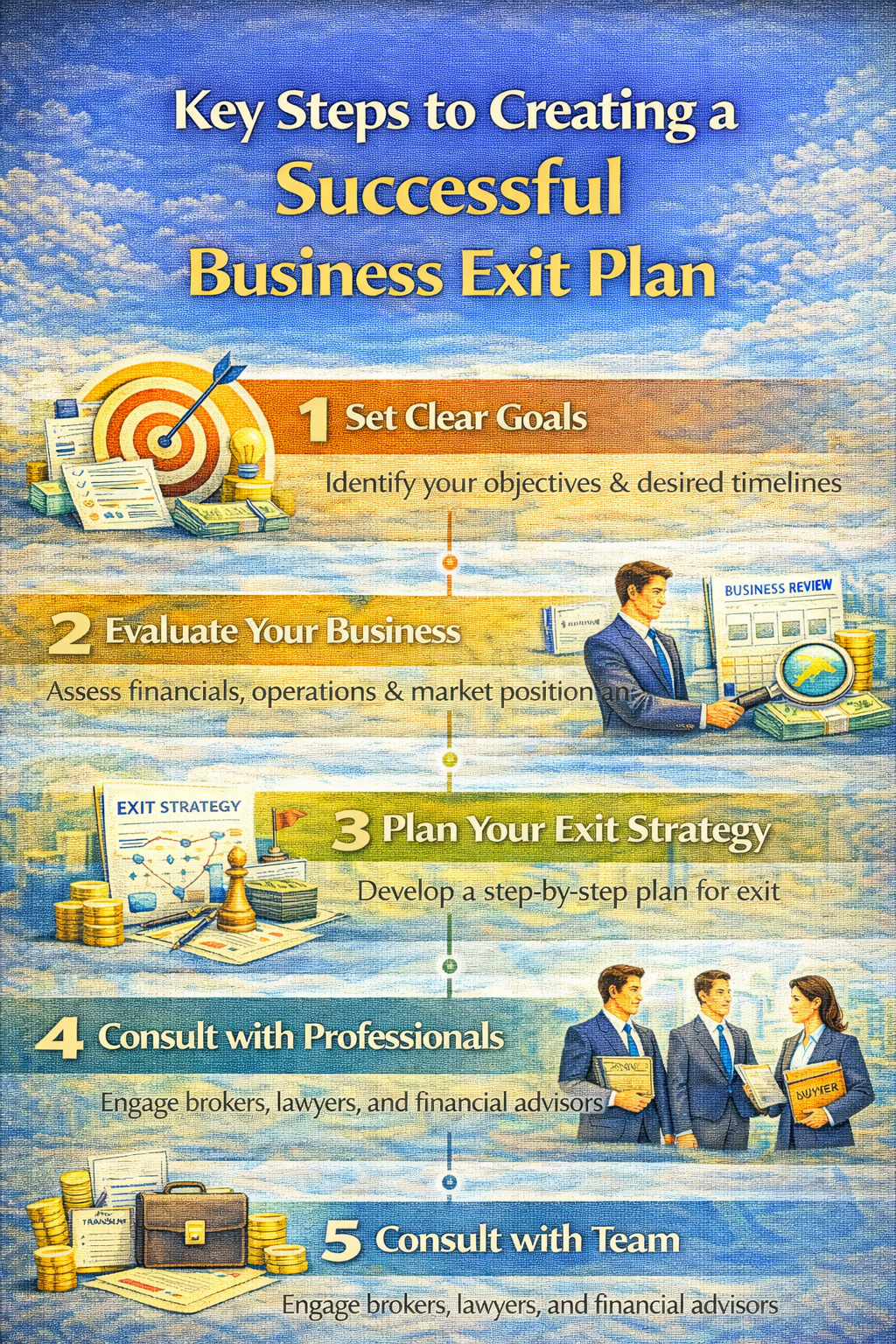
Why Every Business Owner Needs an Exit Plan
An exit plan is more than a one-time event; it's a comprehensive roadmap that prepares your business, yourself, and your stakeholders for a smooth ownership transition. Whether you're aiming to sell, pass the business to family, or pursue another strategy, a well-crafted exit plan aligns your vision with reality. Statistics show that only about 20-30% of businesses successfully sell when owners are ready, often due to lack of preparation. By starting early, you can boost your company's value by up to 20-50% through targeted improvements.
From our experience at Legacy Launch Business Brokers, owners who begin exit planning 3-5 years in advance achieve significantly better outcomes. This process involves evaluating your current position, setting ambitious yet achievable goals, and executing step-by-step actions to bridge the gap. It's not just about the sale—it's about securing your legacy and future freedom.
Step 1: Assess Your Current Business Position
The foundation of any exit plan starts with a thorough assessment of where your business stands today. Begin with a professional business valuation to understand your company's worth. This isn't a guess; it's a data-driven analysis considering financials, market position, operations, and growth potential. Key metrics include revenue trends, EBITDA margins, customer retention rates, and competitive advantages.
Conduct a SWOT analysis—Strengths, Weaknesses, Opportunities, Threats—to identify what makes your business attractive to buyers. For instance, recurring revenue streams or a loyal customer base can significantly increase value. Review your financial health: Are your books clean and audited? Do you have diversified revenue sources? Operational efficiency is crucial; streamline processes to reduce owner dependency, as buyers pay a premium for turnkey operations.
In our work, we've seen businesses double their valuation by addressing key pain points like over-reliance on the founder. Document everything: intellectual property, contracts, employee roles. This step typically takes 3-6 months and sets the baseline for all future planning.
Step 2: Define Your Personal and Financial Goals
Next, clarify your 'why' and 'what next.' What do you want post-exit? Retirement on a beach, starting a new venture, or philanthropy? Articulate personal goals alongside financial ones. Calculate your required proceeds: factor in lifestyle expenses, taxes, debt payoff, and investment needs for 20-30 years.
Consider timelines—aim for 3-10 years depending on your business maturity. Engage a financial advisor to model scenarios, including tax implications like capital gains. Family dynamics matter too; if transferring to heirs, assess their readiness and interests. Our advisors emphasize aligning business value growth with personal wealth targets, often using tools like Monte Carlo simulations for risk assessment.
This step prevents common pitfalls, such as underselling due to unclear goals. We've helped owners realize they needed 30% more value to fund their dreams, prompting strategic pivots early.
Step 3: Build Your Exit Planning Team
No owner exits alone. Assemble a multidisciplinary team: business broker, CPA, attorney, wealth advisor, and possibly an industry consultant. Each brings specialized expertise—brokers maximize sale price, CPAs optimize taxes, attorneys handle legal structures.
At Legacy Launch Business Brokers' exit planning advice, we stress coordinated efforts. For example, restructuring as an S-Corp can save millions in taxes. Vet team members for experience with businesses like yours. Regular meetings ensure alignment. This team not only plans but executes, turning vision into reality.
Step 4: Enhance Business Value and Transferability
Now, implement value acceleration strategies. Focus on three areas: financial performance, operational independence, and growth potential. Improve EBITDA by cutting costs, expanding margins, or entering new markets. Document processes in manuals to make the business run without you—aim for the 'bus test' where it thrives if you're hit by a bus.
Strengthen management: develop key employees into a self-sufficient team. Diversify customers to avoid concentration risks (ideal: no single client over 15-20% of revenue). Invest in technology for scalability. Case in point: one client increased value from $5M to $12M by professionalizing operations over two years.
Regular valuations track progress. Marketing efforts, like building a strong brand, attract premium buyers. Sustainability practices can also appeal to modern investors.
Step 5: Develop and Choose Your Exit Strategy
With preparation done, select the optimal path: strategic sale, financial buyer acquisition, family succession, employee buyout, or liquidation. Each has pros/cons—sales offer liquidity, succession preserves legacy. Evaluate based on goals, market conditions, and readiness.
Prepare marketing materials: teaser, CIM (Confidential Information Memorandum). For sales, identify buyer pools: competitors, PE firms, individuals. Timing matters—sell in upcycles. Explore earn-outs for higher prices with performance contingencies.
We've facilitated deals across industries, matching owners with ideal buyers for optimal terms.
Step 6: Execute the Transition with Precision
Once a buyer is found, negotiate terms: price, structure, contingencies. Due diligence is rigorous—have data rooms ready. Post-sale, plan a transition period (6-12 months) to train successors and ensure retention bonuses.
Address employee communications sensitively to maintain morale. Legal docs like LOIs, PSAs must be airtight. Monitor KPIs during handover. Finally, celebrate and shift to your next chapter.
Common Pitfalls to Avoid in Exit Planning
Many owners fail by waiting too long, overvaluing emotionally, or ignoring taxes. Lack of confidentiality risks leaks. Emotional attachment clouds judgment—use advisors for objectivity. Incomplete documentation derails deals. Procrastination erodes value; start now.
Market volatility demands flexibility—have contingencies. Overlooking personal readiness leads to post-exit regret. Our Legacy Launch services help navigate these expertly.
Real-World Case Studies from Our Experience
Consider a manufacturing firm: owner assessed at $8M valuation. Through team assembly and ops streamlining, value hit $18M in 4 years, sold to a strategic buyer. Another, a service business, transitioned to children via structured succession, preserving family harmony and value.
These successes stem from methodical steps, proving the process works across sizes.
Measuring Success and Long-Term Impact
Success metrics: achieved sale price, smooth transition, post-exit satisfaction. Track wealth growth, legacy continuity. Annual reviews keep plans current.
Exit planning builds resilience today while securing tomorrow.
Frequently Asked Questions
How long does it typically take to create and execute an exit plan?
Creating a solid exit plan takes 3-6 months for initial assessment and goal-setting, but full execution often spans 3-5 years or more, depending on your business size and desired improvements. Starting early allows time to enhance value, assemble the right team, and align market conditions. For smaller businesses, a 1-2 year plan might suffice for a quick sale, but comprehensive strategies yield higher returns. Factors like industry cycles, economic climate, and internal readiness influence timelines. Regular milestones ensure progress, with annual valuations tracking gains. Owners who rush often leave money on the table, facing prolonged negotiations or lower offers. By dedicating time upfront, you position your business as premium, attracting top buyers and optimizing outcomes. Professional guidance accelerates this without cutting corners.
What is the first step in creating an exit plan?
The first step is a comprehensive business valuation and current state assessment. This establishes your baseline worth through financial analysis, market positioning, and operational review. Engage a certified appraiser to calculate enterprise value using methods like DCF, comparables, or asset-based approaches. Simultaneously, perform a SWOT analysis to pinpoint strengths like strong cash flow and weaknesses such as owner dependency. Review key documents: financials, contracts, IP. This data informs realistic goals and gaps to bridge. Skipping this leads to misguided strategies. In practice, this phase reveals hidden value drivers, setting a clear path forward and motivating action.
Why is building an exit planning team important?
A multidisciplinary team—broker, CPA, attorney, advisor—provides expertise across finance, tax, legal, and strategy, ensuring holistic planning. Solo efforts miss nuances like QSBS tax exclusions saving millions. Teams coordinate to avoid silos, optimizing every aspect. Experienced professionals spot opportunities, negotiate better, and mitigate risks. For complex exits, this is non-negotiable. Costs are offset by higher net proceeds. Choose based on track record with similar businesses. Regular huddles keep momentum. Ultimately, the right team turns a good plan into exceptional results, safeguarding your legacy.
How can I increase my business value for exit?
Boost value by improving EBITDA (target 15-25% margins), reducing owner reliance via documented processes and strong management, diversifying revenue/customers, and demonstrating scalable growth. Clean financials, audited statements, and IP protection are key. Invest in tech for efficiency. Strategic add-ons expand markets. Aim for recurring revenue models. Track progress with quarterly KPIs. Owners who've implemented these see 2-3x value lifts. Focus on buyer priorities: predictable cash flow, low risk, high growth. Professional audits enhance credibility during due diligence.
What are common exit strategies for business owners?
Popular strategies include strategic acquisition (synergies with competitors), financial buyer sale (PE firms for cash flow), family succession, management/employee buyout (ESOPs), or IPO for larger firms. Liquidation suits distressed cases. Choose based on goals, timeline, control desires. Sales offer liquidity; succession preserves legacy. Market timing matters—assess via advisors. Hybrids like earn-outs bridge valuation gaps. Each requires tailored prep, from teasers for sales to training for transitions.
What tax considerations are involved in exit planning?
Taxes can consume 20-40% of proceeds; plan with CPAs for structures like installment sales, charitable trusts, or entity conversions (C to S-Corp). QSBS excludes up to $10M gains. Estate planning integrates gifting, trusts. State taxes vary. Model scenarios pre-exit. Post-1031 exchanges defer gains. Early planning saves substantially, funding more retirement security. Always consult specialists for compliance.
How do I prepare for due diligence in a business sale?
Organize a virtual data room with 3-5 years financials, contracts, IP docs, employee records, customer lists (anonymized). Audit books, resolve disputes. Standardize reporting. Train staff on processes. Anticipate 100+ requests. This speeds closings, builds buyer confidence, prevents surprises. Brokers guide preparation, often starting 12 months pre-marketing.
What role does personal goal-setting play in exit planning?
Personal goals drive the plan—financial needs, lifestyle post-exit, family involvement. Calculate runway: expenses x 25-30 for nest egg. Align business growth accordingly. Unclear goals lead to suboptimal exits. Advisors model 'what ifs.' This ensures fulfillment beyond money, preventing regret. Integrate estate, philanthropy plans.
Can small businesses benefit from formal exit planning?
Absolutely—small businesses gain most proportionally. Valuations rise via professionalization, even if selling to individuals. Plans mitigate risks like illness. Simple strategies like owner financing appeal broadly. Start small: valuation, basic team. Yields liquidity, legacy protection regardless of size.
What happens after the business exit?
Post-exit, focus on transition support (6-12 months), then personal pursuits. Invest proceeds diversely for income. Enjoy freedom, new ventures, or giving back. Monitor non-competes. Many owners thrive via planning. Celebrate achievements; reflect on lessons for future endeavors.
Ready to Start Your Exit Plan?
Creating an exit plan empowers you to control your destiny. Begin with assessment today for tomorrow's success. Contact Legacy Launch Business Brokers for expert guidance tailored to you.